A selection of coursework, research, and personal projects spanning 2.5D masocore action, narrative design, serious games, and UI/UX, each built from a design-first perspective and grounded in theoretical frameworks.
7
PROJECTS
2
ENGINES
4
GDDs
N=12
EMPIRICAL STUDY
How do you design a masocore game that's brutally hard, but never unfair? I ran a controlled experiment to find out.
A brutally unforgiving hunter-action platformer. Research-backed design featuring empirical study on Cognitive-Mechanical Interference.

My contribution: core concept, design pillars and combat/progression systems spec for a 6-person studio pitch.
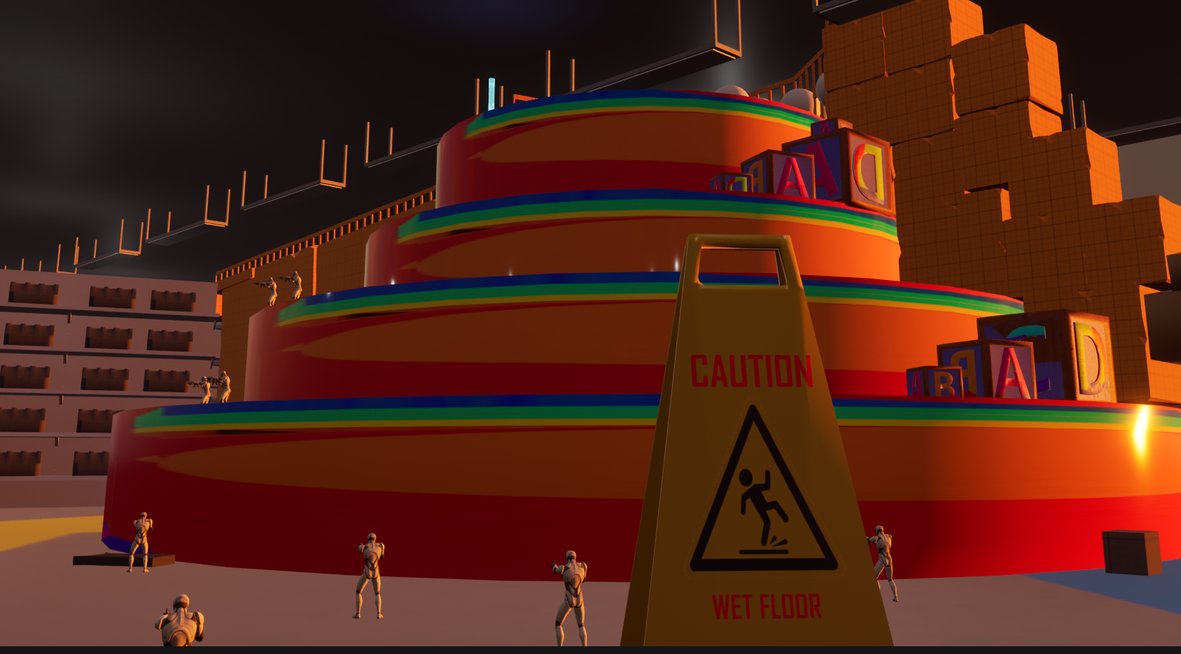
Group project (studio: Unreally Good). An escalating third-person shooter set inside a giant, oversized toy shop, where rogue AI action figures must be stopped using nerf guns, batteries and improvised traps. Co-designed with Gareth; system architecture documented for programmer Liam.
What if the environment itself was the only feedback system: no HUD, no stat bars, just the world?
A first-person narrative simulation about work-life balance and burnout. Diegetic stats replace HUD. The world is the feedback.
Design a level that teaches stealth through space and consequence alone: no tutorials, no waypoints.
A stealth game pitch and fully documented level design: ninja infiltration through a feudal Japanese village toward a guarded warlord's castle. Built in Unreal Engine with parkour, enemy AI, and dynamic sound propagation.
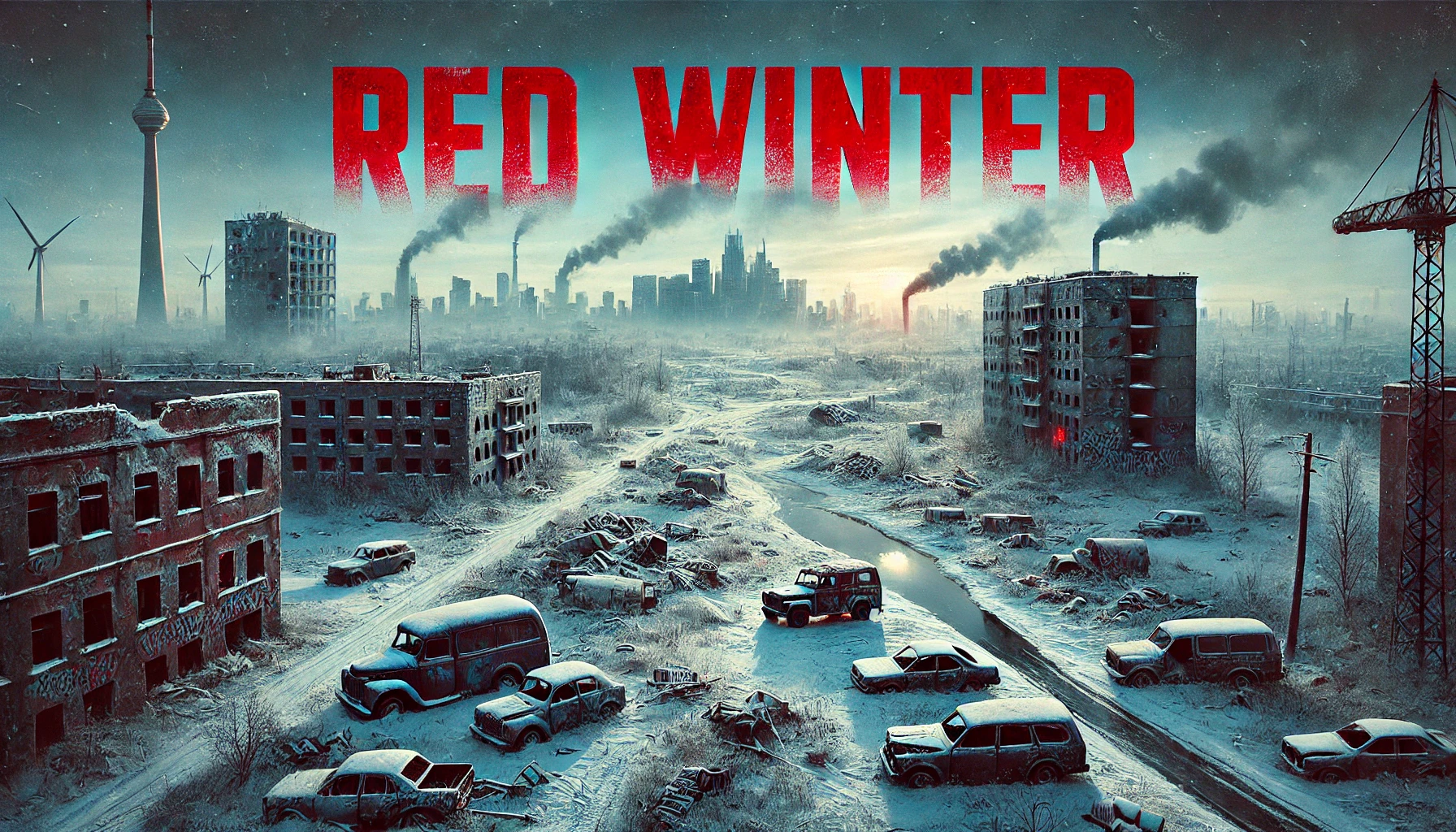
My contribution: scripting the branching narrative and Figma prototype for Scene 04 in a group FPS concept.
Group project. World design and narrative direction shared with Gareth & Luke. The branching script and interactive prototype for Scene 04: Winter's End are Steve's individual contribution.
An 80s horror platformer with three distinct zones, four weapon types, and a fully documented GDD.
An 80s-horror pixel platformer built in Unity: ghosts, graveyards and a supernatural small town. Three distinct zones, four weapon types, and a fully documented GDD.
How do you design a TCG UI that communicates complex interactions without overwhelming the player?
A multiplayer trading card game built in Unity: four elemental factions, deck-building, and a fully designed UI/UX system prototyped in Figma across three iterative playtest cycles.
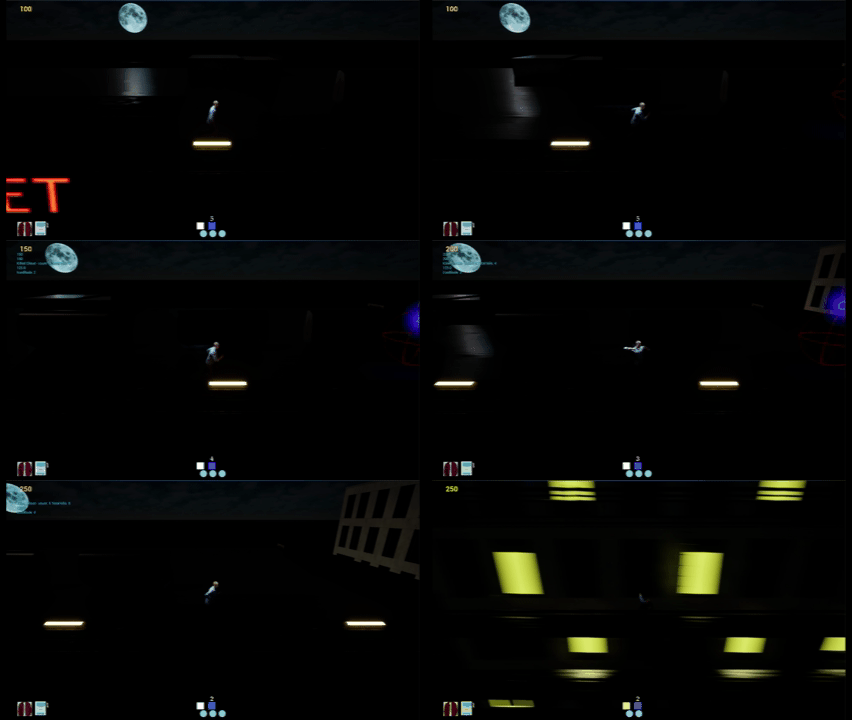
Create horror through environmental design alone: no monster, no jump scare, just architecture and what's left behind.
A sci-fi/horror walking simulator based around 1970/80's horror films.
PERSONAL PROJECTS
Projects built outside of assessment: concepts, systems, and experiments developed on my own time.
Add your project description here.
EXTRACURRICULAR
Side experiments and personal projects that don't fit neatly into a portfolio but show how I think when nobody's marking it.
A fully playable first-person dungeon crawler built in vanilla HTML/CSS/JS. Character creation, turn-based combat, loot, levelling. Worth a look. Built for the love of it.
"You left the family business. The family business never left you."
The Brief
Build a masocore 2.5D platformer that is hard but never unfair. Then run a controlled experiment to find out whether it actually is.
Role
Solo Designer & Developer
Timeline
Sept 2025–Jan 2026
Engine / Tools
Unreal Engine 5
Module
GAM6503 · UoGM
A brutally unforgiving 2.5D masocore action-platformer in which you play a hunter from a legendary lineage, outmatched in strength, relying on perfect timing, strategic preparation, and flawless execution to survive. Armed with ancient lore and whatever's in the trunk, you track demons, vengeful spirits, and vampires across forgotten American highways. One wrong weapon choice means certain death.
Solo Designer & Developer: Concept, Mechanics, GDD, Unreal Engine Prototype, Research Design
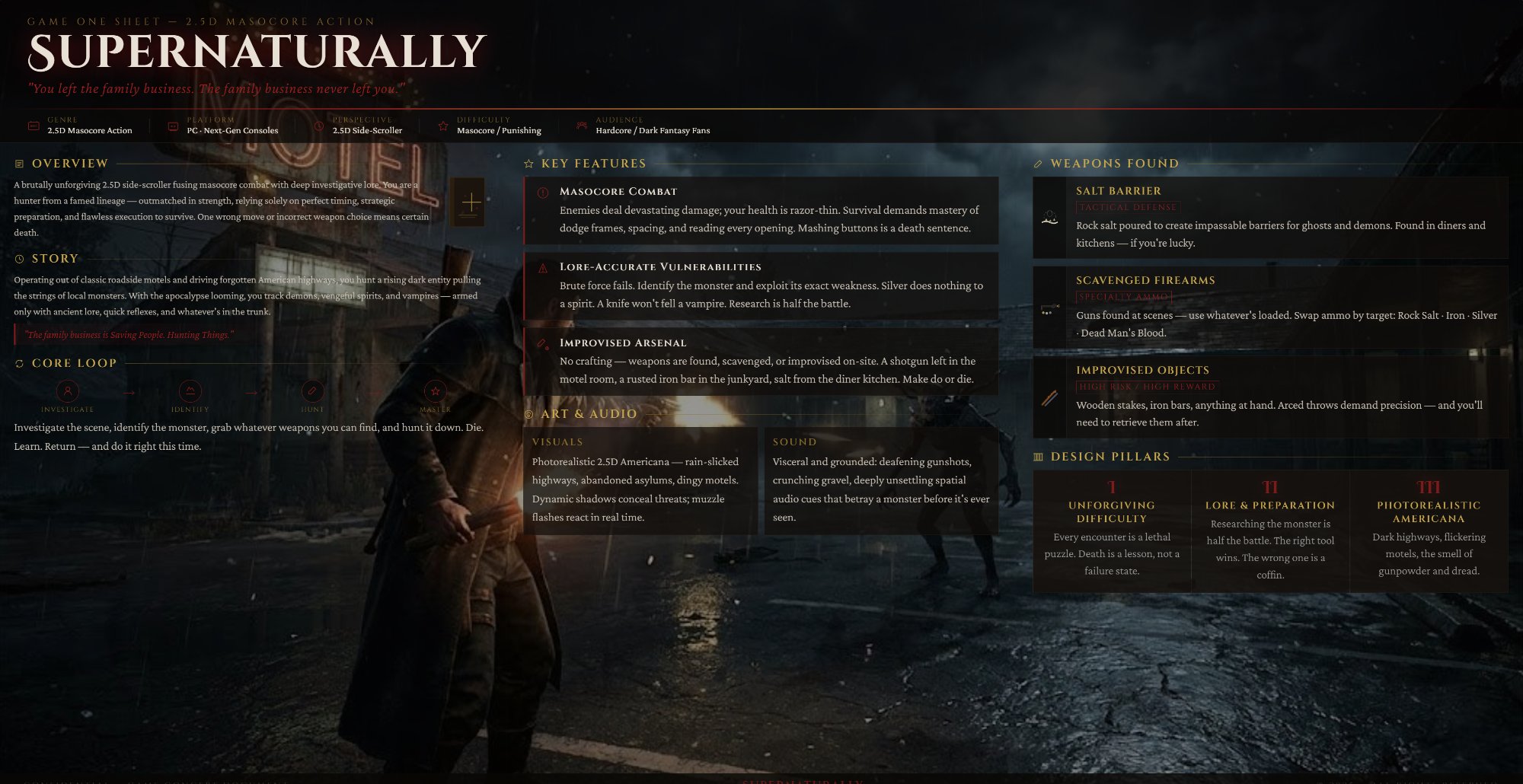
A full-page pitch document summarising Supernaturally's genre, story, core loop, key features, weapons, design pillars, and art direction, produced as a standalone marketing and design reference.
Supernaturally sits at the intersection of masocore precision and investigative horror. Inspired by the committed-movement legacy of Ghosts 'n Goblins and the combat-puzzle philosophy of DOOM Eternal, the game challenges players to identify monster archetypes and match their weapons accordingly, under punishing time pressure and rigid platformer physics that do not forgive hesitation.
Rigid platformer physics force decisions before jumps. No mid-air corrections; commitment is the mechanic.
Every monster follows its mythology. Silver fails on spirits. A knife won't fell a vampire. Knowledge is survival.
Colour-coded visual affordances ensure every death is legible. Challenge stays internal: the player's skill, not the system's opacity.
The central mechanic: enemies are immune to incorrect weapon types. The player must identify the creature type from environmental cues and visual tells, then select the correct weapon before engaging. Using the wrong tool deals no damage and wastes precious ammunition.
Each enemy archetype has distinct colour and shape tells. Players learn to read them by instinct rather than stopping to think, and the research study confirmed this works under the time pressure masocore creates.
BSc Games Design, Practical Development Research (GAM6503) · University of Greater Manchester · Jan 2026
Balancing "Masocore" Difficulty with Cognitive Accessibility · Word Count: 3,985
This study evaluated the impact of enemy-specific vulnerability systems on player performance and psychological flow within high-difficulty 2.5D platformers. Using a counterbalanced within-subjects experiment (N=12), the study tested whether aggressive visual affordances could mitigate CMI under time pressure. Results demonstrated combat efficiency significantly improved (4.2 shots per kill) without triggering external failure attribution or flow breakdown.
Visual affordances successfully bypassed analytical processing across all 12 sessions.
73% Internal ("I need to improve my skill") · 27% External
Zero flow loss recorded even in the external-attributing group.

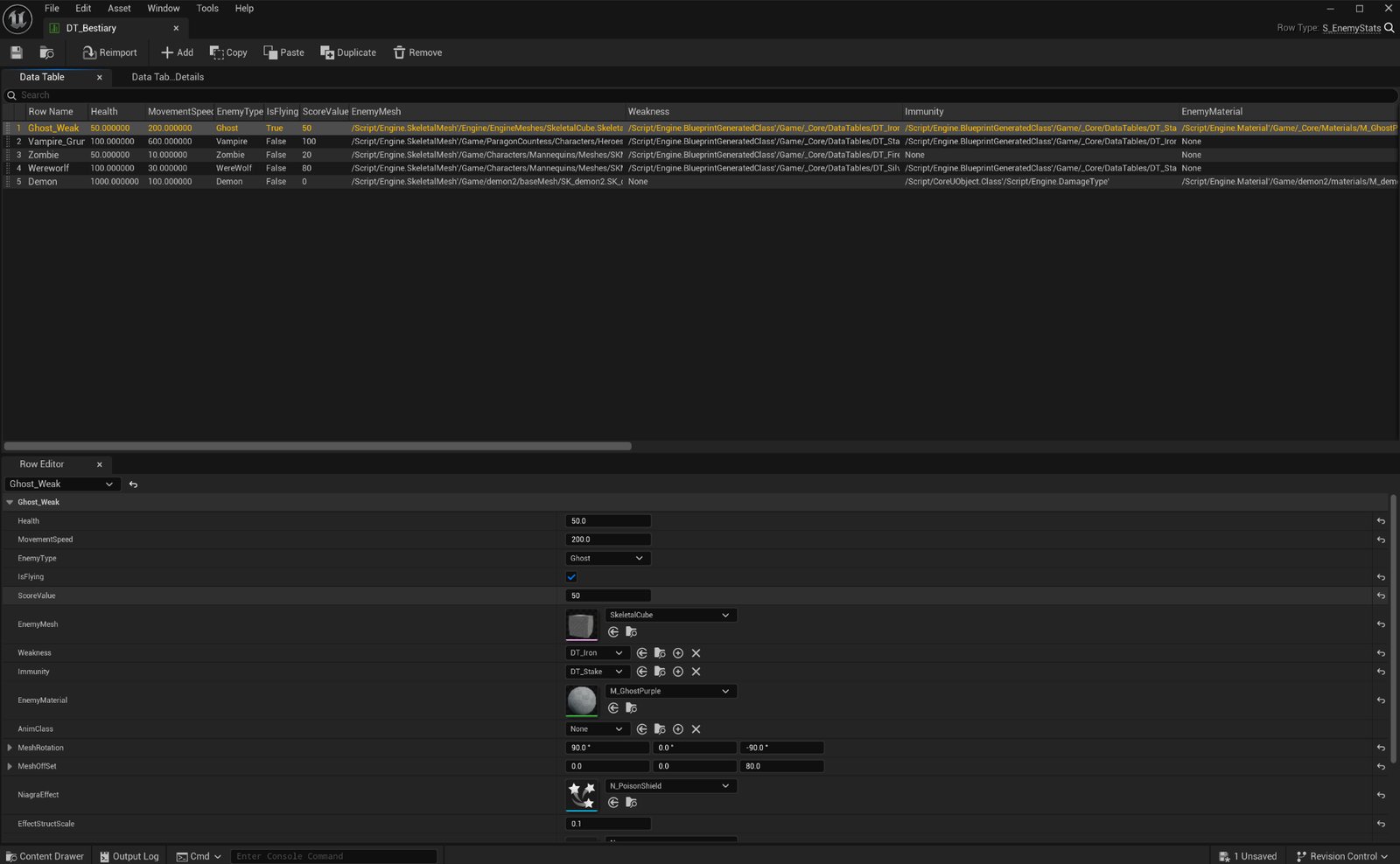
DT_Bestiary: Per-Enemy Weakness & Immunity Data

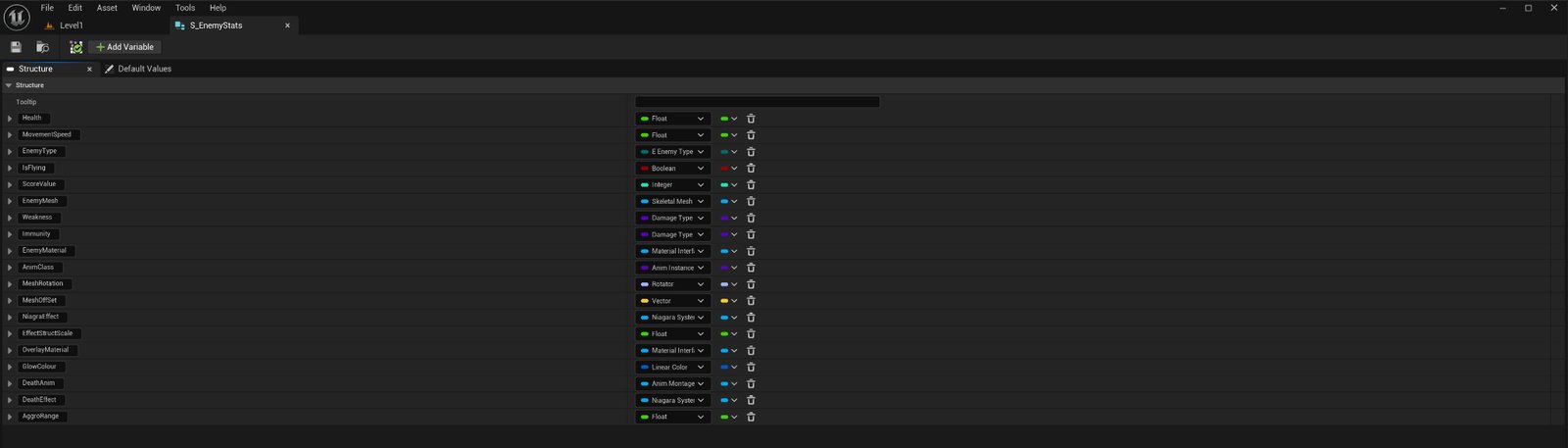
S_EnemyStats Struct: Shared Enemy Variables

Weapon State Machine: Immunity Lookup

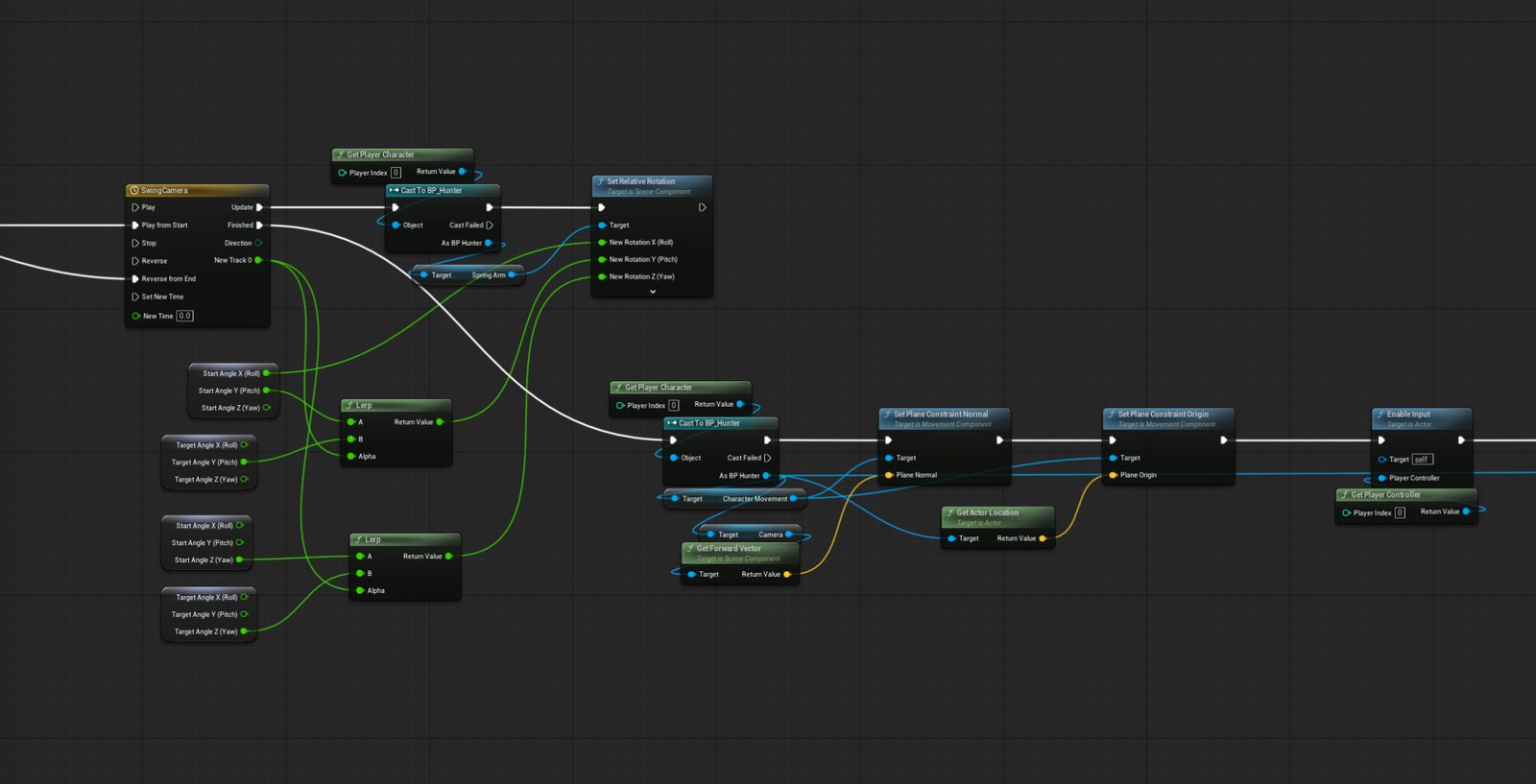
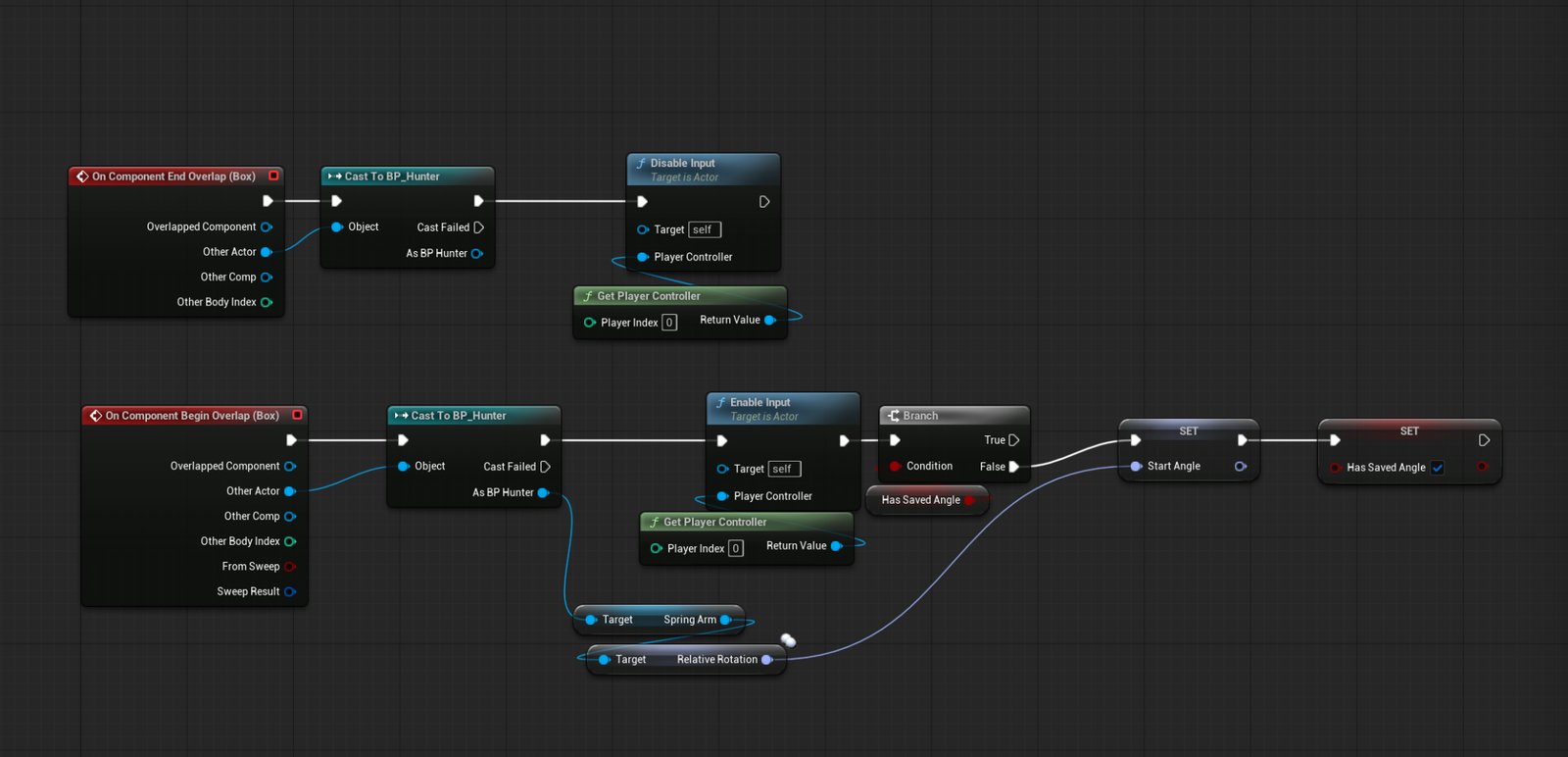
Axis-Pivot Trigger Volume & Camera Rig

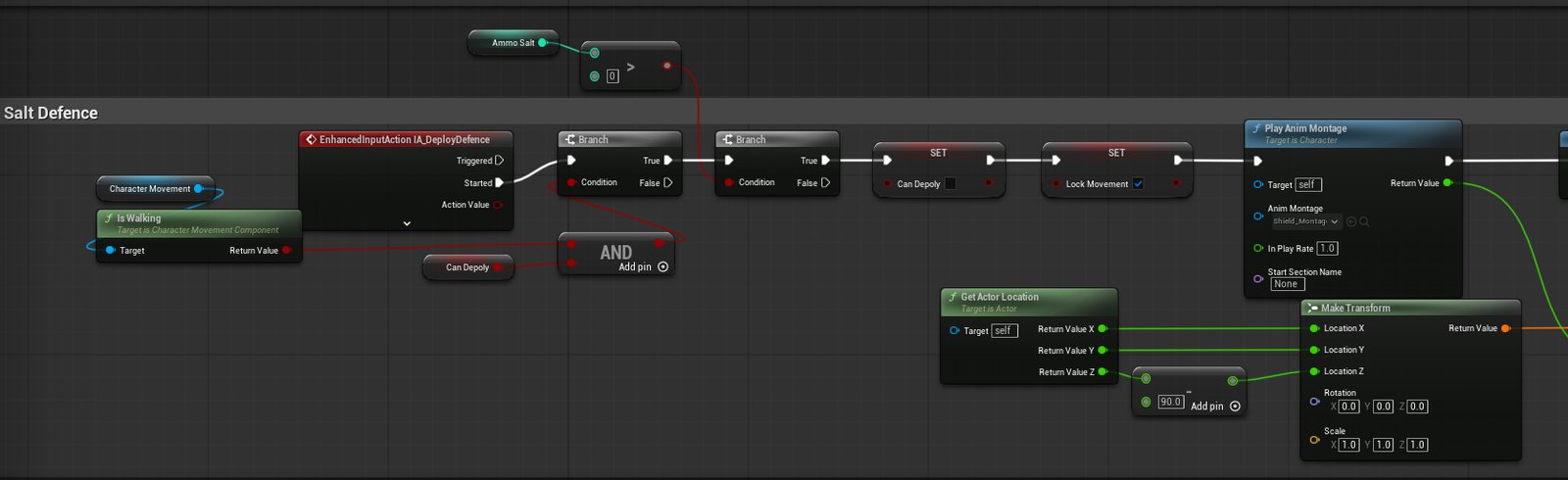
Salt Defence: Deploy Logic & Niagara Trigger

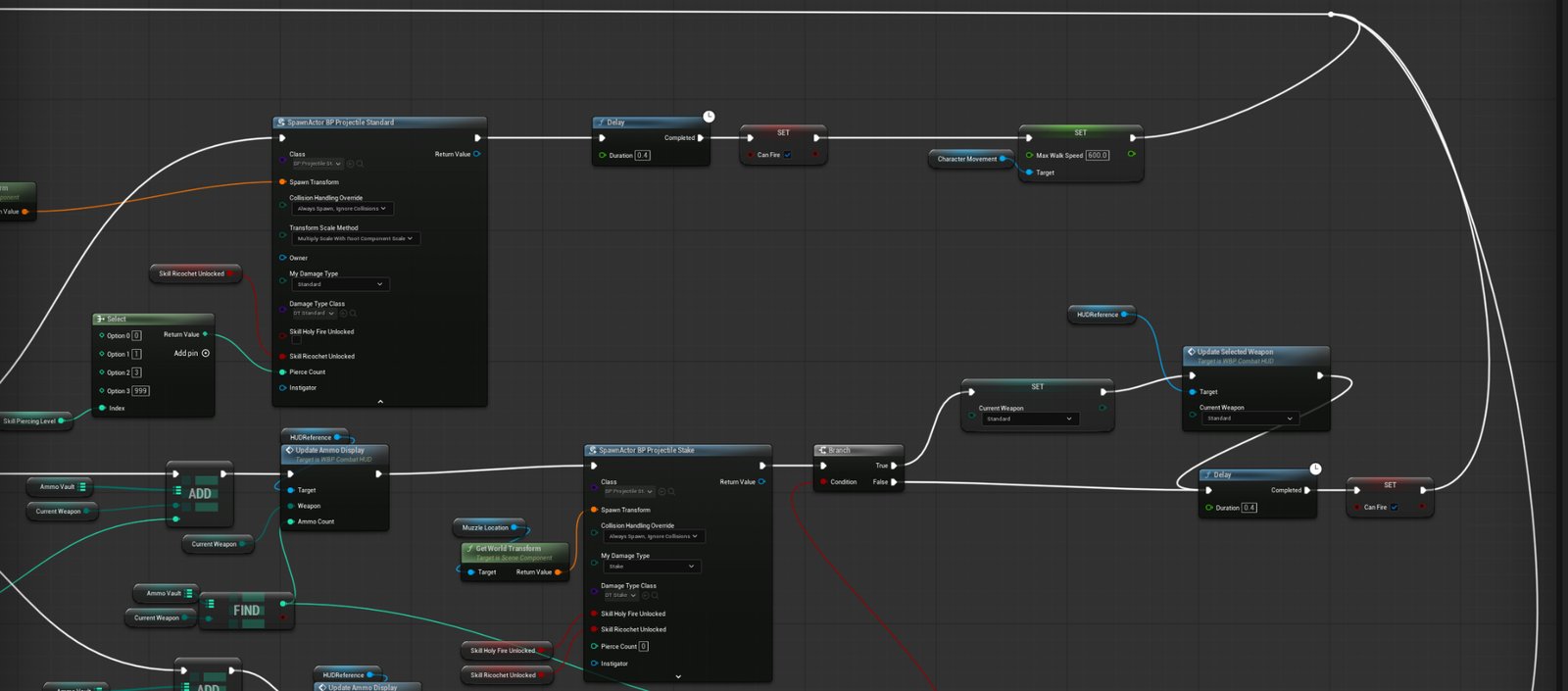
Resource Scarcity: Carry-Limit Logic

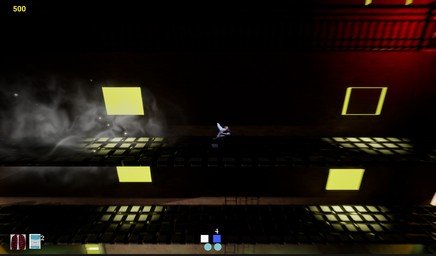
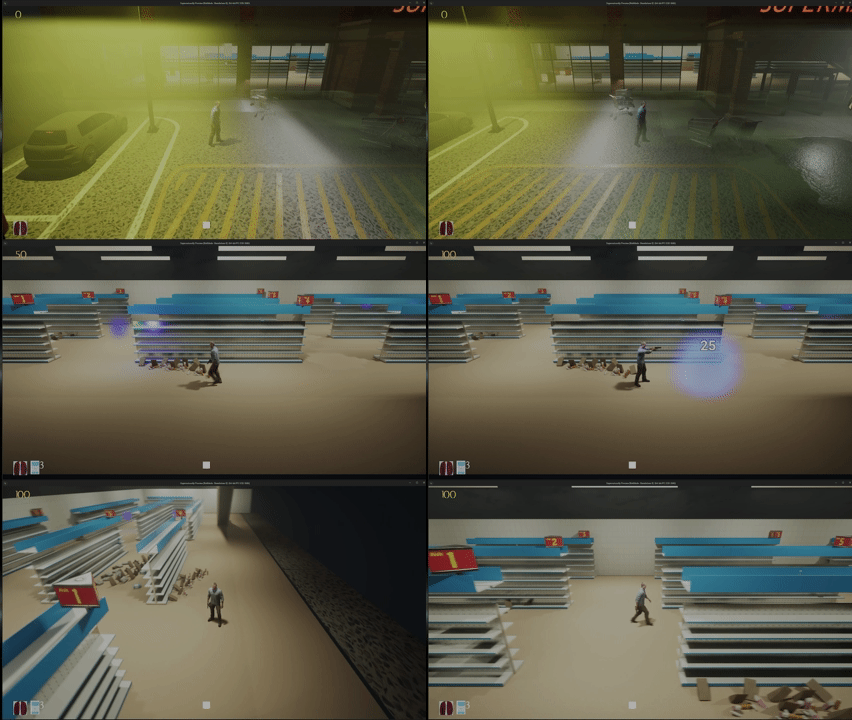
Vampire Red Ambient Visual Affordance

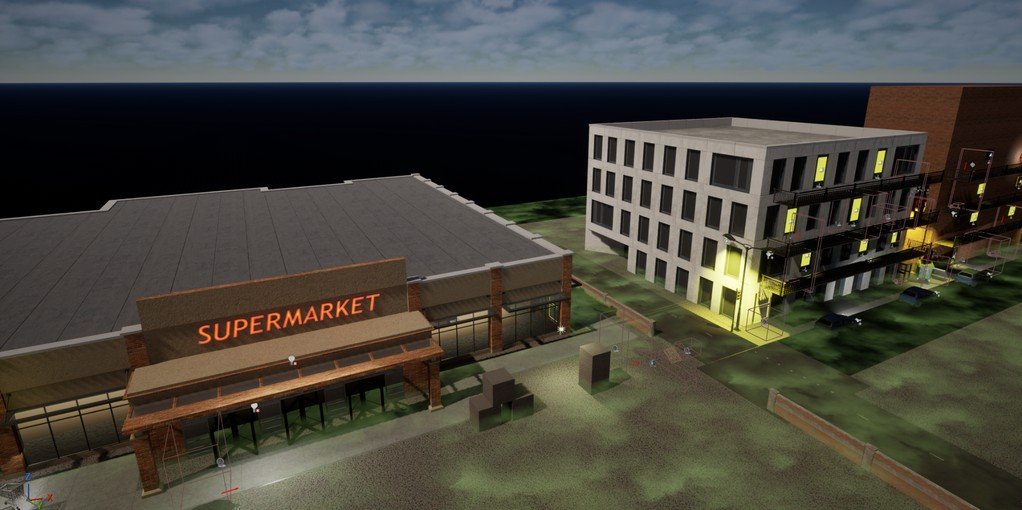
Supermarket Sub-Level Entrance

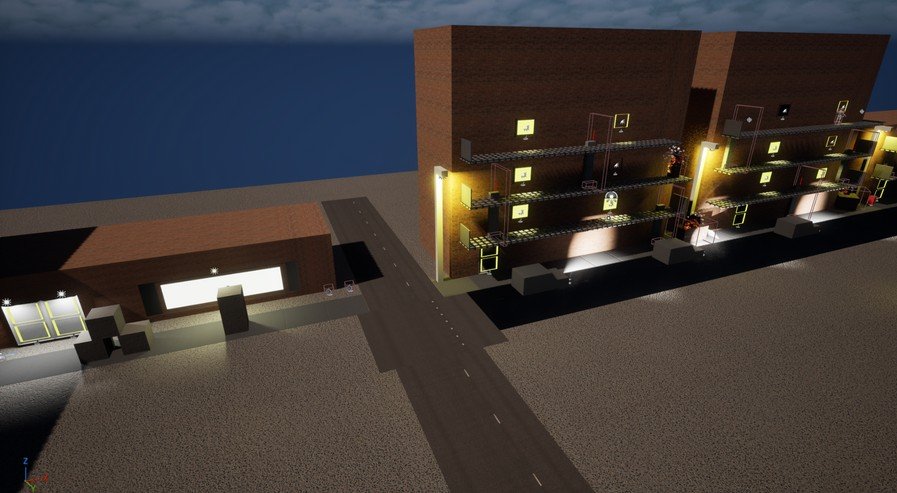
City Street: Apartment Block at Night

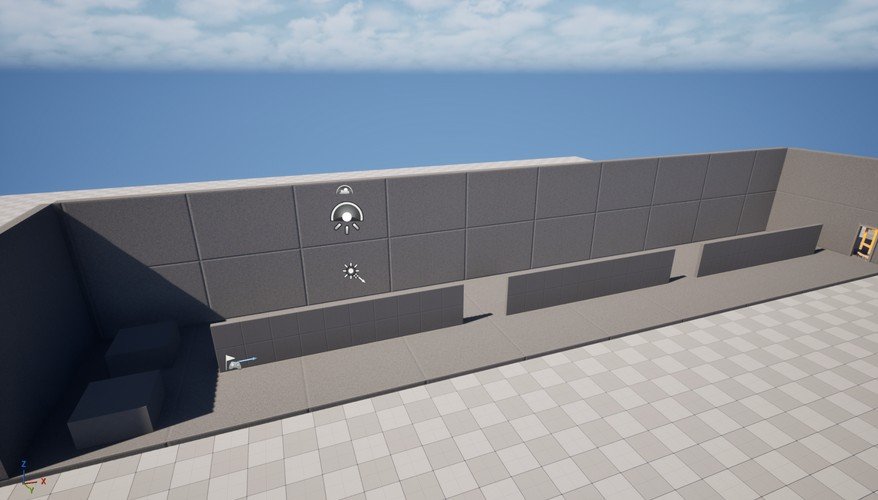
Greybox 'Gym': Mechanic Prototyping

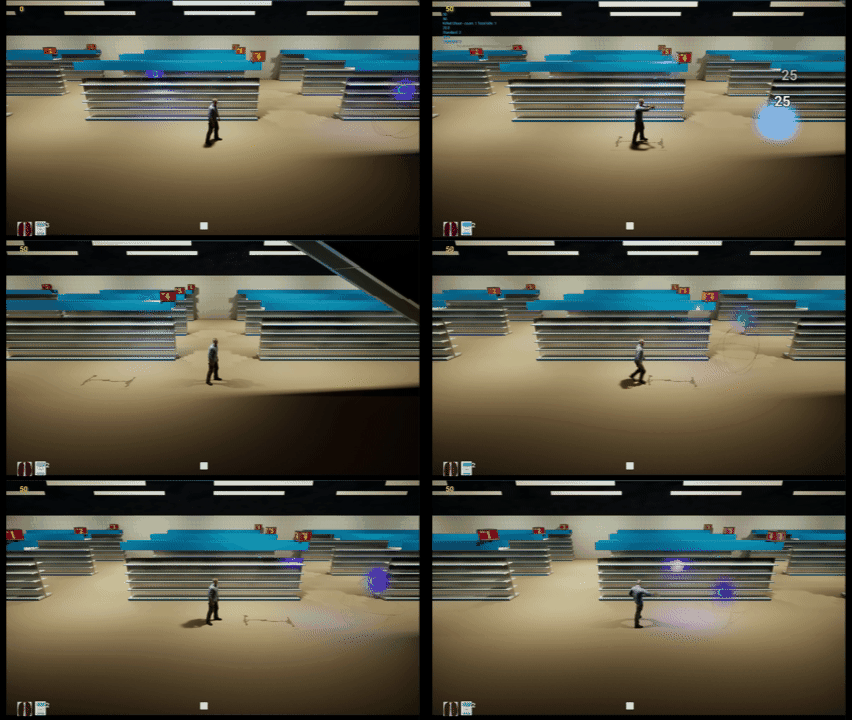
Control Condition: Universal Vulnerability

Variable Condition: Hard-Lock + Affordances
The full GAM6504 VIVA presentation: aims and goals, the lore-first design methodology, academic theory (MDA, SDT, Flow, CMI), research impact data, blueprint system breakdowns, the sprint-by-sprint project journey, issues and solutions, and critical reflection.
Supernaturally VIVA Presentation · GAM6504 Major Project
Download Presentation PDF"Some disassembly required."
The Brief
Pitch a commercially viable third-person shooter as a 6-person studio: a full concept, GDD, systems architecture and go-to-market plan, built and presented as "Unreally Good."
Role
Designer (with Gareth)
Team
6 · Unreally Good
Engine / Tools
Unreal Engine 5.7
Deliverable
GDD + Pitch Deck
An escalating third-person shooter set inside a giant, oversized interactive toy shop. An electrical pulse has fried the safety protocols of the store's newest AI-powered toys, and it's down to one military-style action figure, armed with nerf guns, battery grenades and improvised traps, to find the fuses, restore power, and shut the rebellion down before it reaches the street. Pitched as a full commercial proposal (pricing, platforms, launch roadmap and monetisation) under the studio name "Unreally Good."
Game Designer, co-designing the core concept and design pillars with Gareth, and writing the systems specification (progression, health and projectile architecture) handed to programmer Liam. Josh, Daniel and Jack delivered the art and 3D renders shown below.
An electrical pulse has fried the safety protocols of a retail toy shop's newest AI-powered action figures. Playing a military-style toy of their own, the player must climb seven oversized retail floors, locating fuses to restore power while the rebelling toys swarm to escape into the wider world. The premise deliberately pairs a non-lethal, light-hearted plastic aesthetic with a tactical, escalating shooter underneath: "Cognitive Contrast" as a hook for engagement, the same research-backed framing used on the team's other research-driven prototypes.
The loop repeats and escalates across seven retail zones until the player reaches the win state: an EMP built from gathered fuses that wipes out the sentient toys for good.
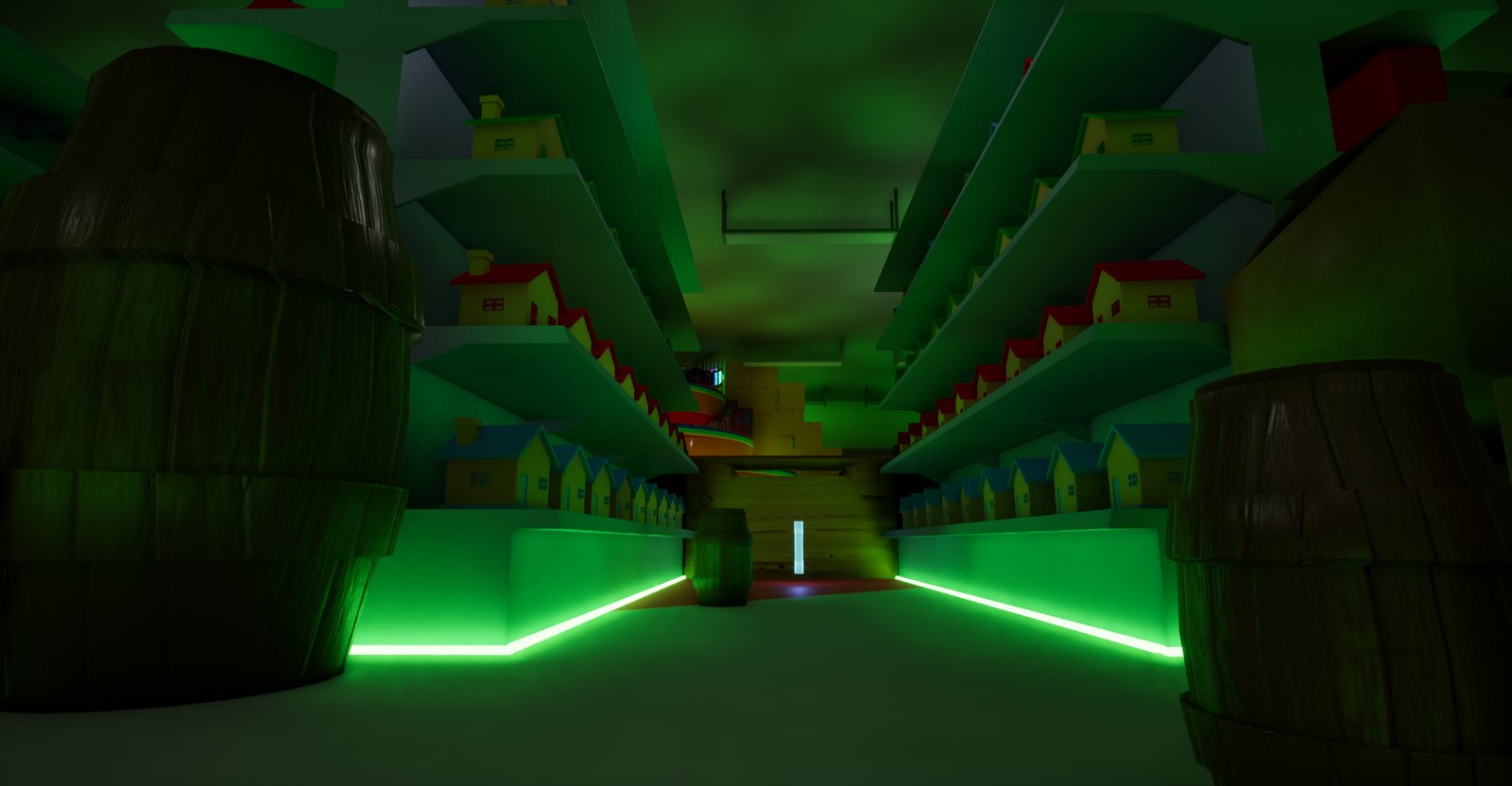
Oversized shelving, cover and traversal objects define every encounter. Spatial awareness and verticality matter more than raw aim, so the landscape is as much a weapon as the player's guns.
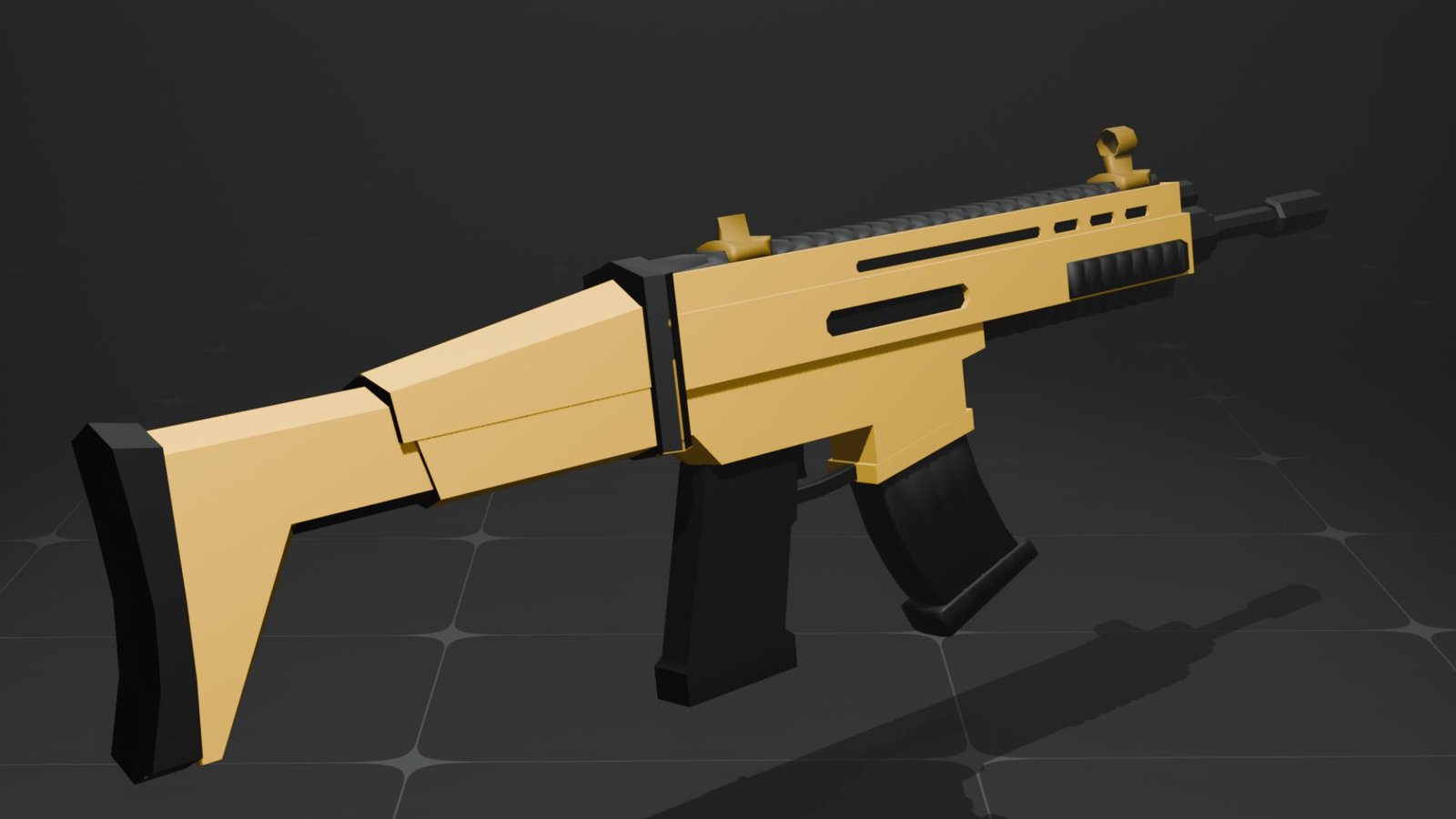
No military hardware: nerf guns, batteries and household objects like staplers and drawing pins become traps and weapons, encouraging experimentation with loadouts.
Played in third person as a military-style action figure. The jetpack is the core traversal verb: limited fuel that regenerates on landing, used to reach elevated shelving and combat positions. Jump, crouch, omnidirectional aiming and all movement/weapon animations were built and adapted specifically for the toy-scaled character.
| Weapon | Damage | Environmental Effect |
|---|---|---|
| Nerf Pistol | Minor | Can shift small objects |
| Nerf Assault Rifle | Moderate | Several shots destroy some terrain |
| Battery Grenade | Area effect | Destroys environment in one hit |
| Grenade Launcher | Area effect, long range | Fires grenades at distance |
Action figures sharing the player's scale, found either boxed or already broken free. Their safety features have been fried by the same pulse that empowers the player. Early-tier enemies break out of their packaging when the player approaches and run a simple behaviour tree (avoid obstacles or attack); later tiers introduce swarm AI and a second enemy archetype to keep the escalating pressure loop intact across all seven zones.
Specified as a designer working directly with the team's programmer (Liam): data-driven, designer-configurable C++ components built for rapid iteration and long-term maintainability in UE5.7.
Wraps an EntityStats PrimaryDataAsset holding multiplier values for damage, speed and health, plus XP and level-up tracking. Stats are editable directly in the Details pane, or read/written at runtime via C++ or Blueprint. An OnLevelUp event fires on level-up so Blueprint logic can react (VFX, audio, UI) without touching the underlying data asset.
Manages object health via Unreal's native OnTakeAnyDamage event, requiring a valid projectile hit to register. Exposes OnTakeDamage, OnHeal and OnDeath events to Blueprint, keeping combat reactions designer-editable without C++ changes.
A base class wrapping Unreal's projectile movement and an ApplyDamage-based damager. Initial speed, max speed, bounciness and homing behaviour are all exposed as editable properties, so designers can create new projectile variants without writing code.
Spawns any ProjectileBase-derived projectile through a Blueprint-exposed SpawnProjectile function, with fire rate and autofire toggles, letting weapon behaviour be tuned entirely in Blueprint while the projectile logic stays centralised in C++.
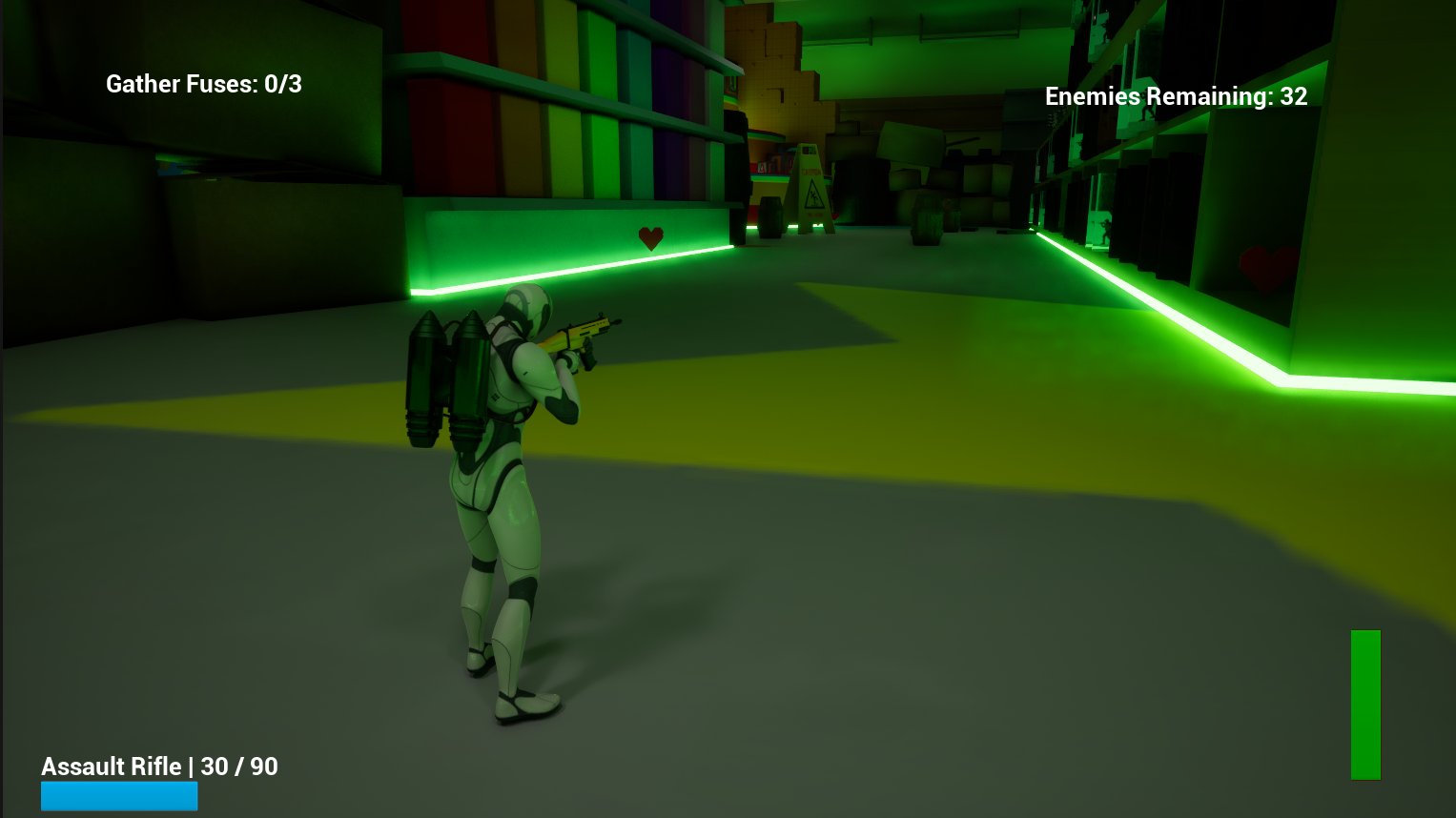
The HUD shows health, stamina, weapon type and per-weapon ammo count, with clean progress bars for jetpack fuel and health to stay legible mid-combat. Aiming switches to a stylised, computer-vision-style viewport, reinforcing that the player is seeing the world through an AI toy's eyes rather than human optics.
Relies on traditional FPS movement and small enemy counts; Plastic Protocol differentiates with scale-driven verticality and large-scale swarms.
EDF overwhelms with swarms using real military soldiers; Plastic Protocol keeps the swarm-combat hook but reframes it through a light-hearted, non-lethal toy aesthetic.

Oversized Shelving Corridor

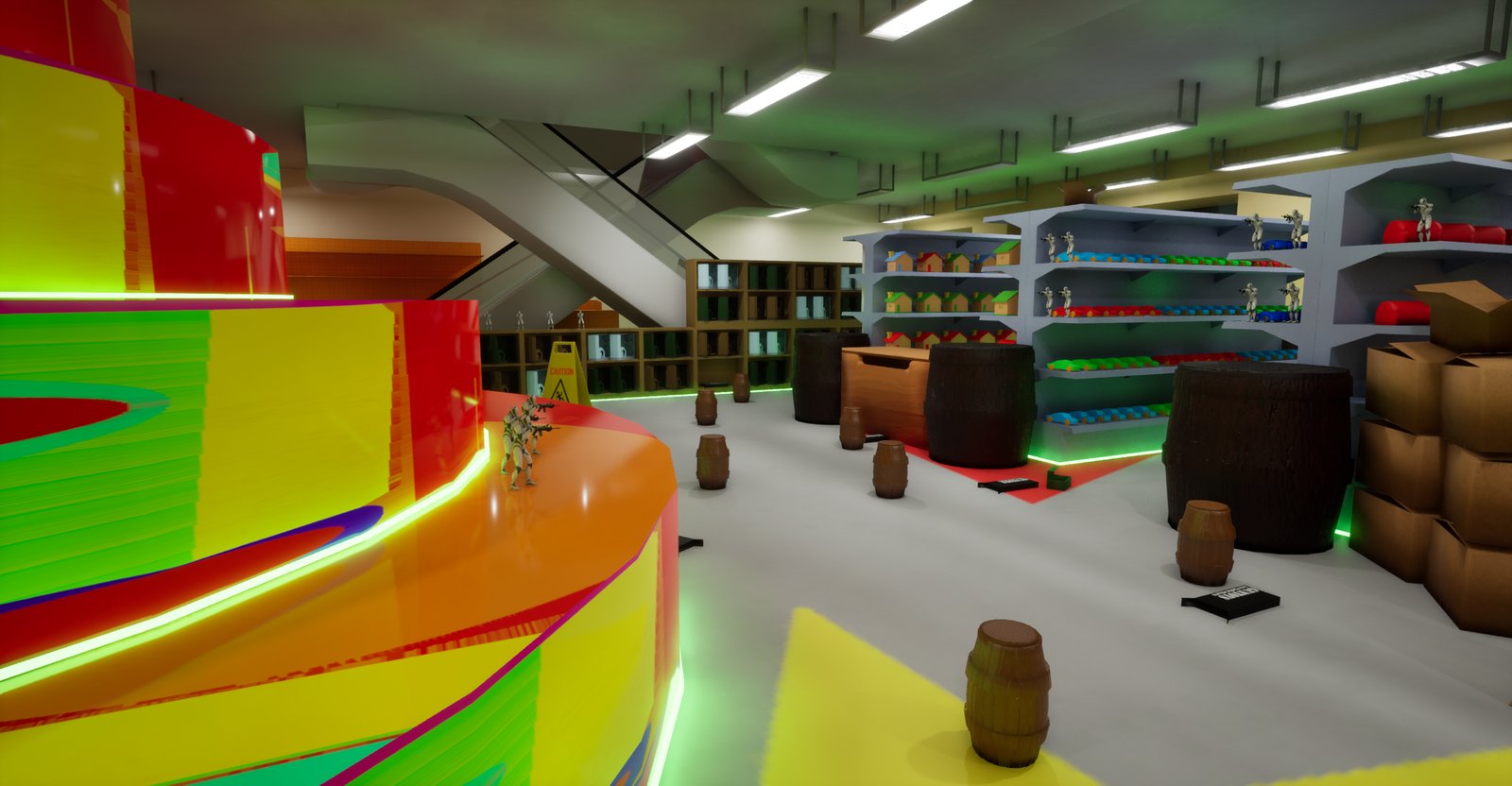
Combat Floor: AI Toys on the Shelves

Diegetic HUD: Fuses, Enemies, Ammo

Weapon Render: Nerf Assault Rifle

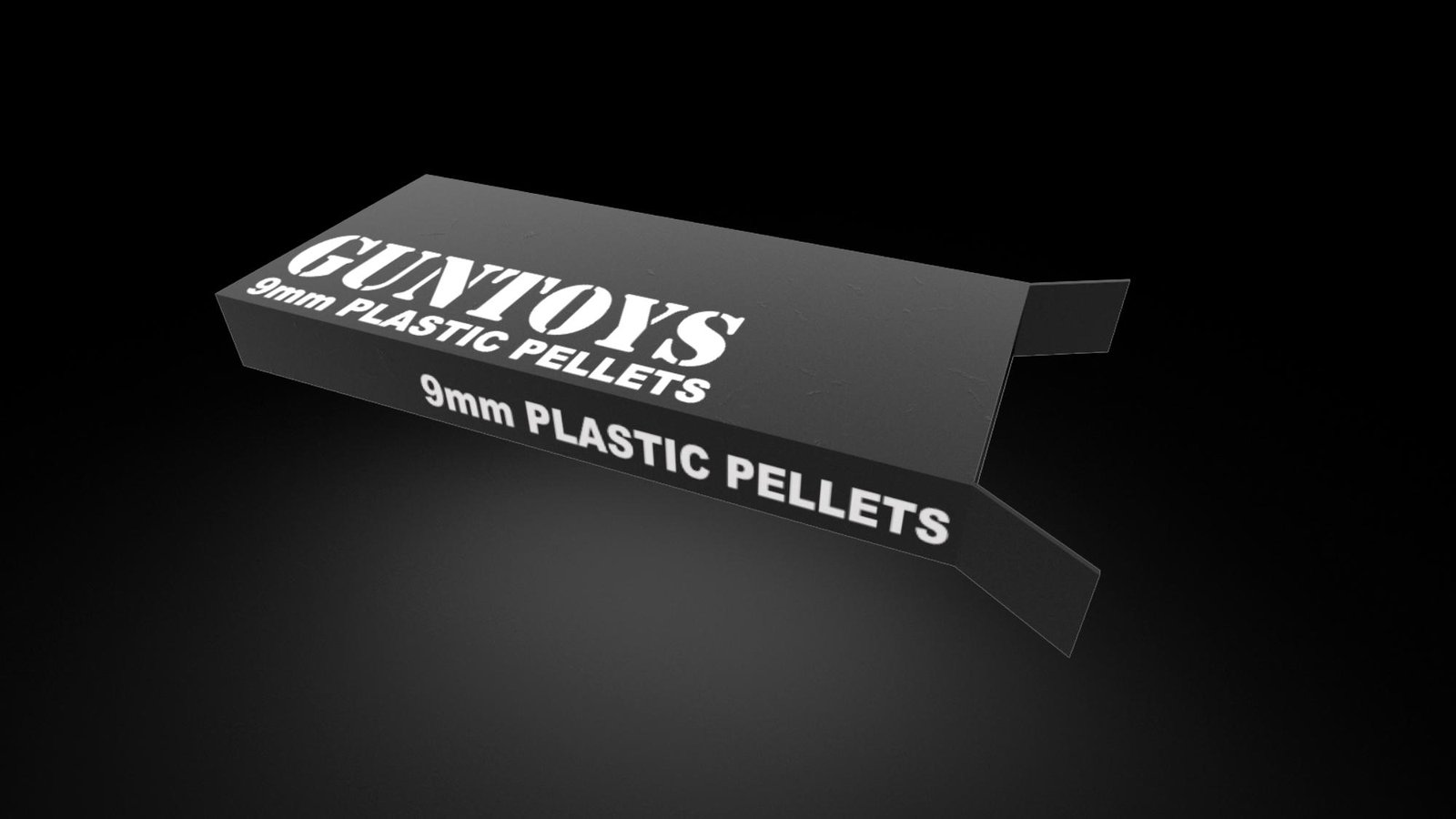
Prop Render: GUNTOYS Ammo Box

Key Art: Swarm at the Spiral Stack
Visual reference for the systems specified in the Systems Architecture tab, implemented in Blueprint and C++ by the team's programmer (Liam) from this designer's spec.
EntityUpgradeComponent: Stat Multipliers & XP
HealthComponent: Damage / Heal / Death Events
ProjectileBase: Movement & Damage Application
ProjectileSpawner: Fire Rate & Autofire
Jetpack Traversal: Fuel & Ground-Landing Regen
Enemy Behaviour Tree: Avoid / Attack
The full GDD covering scope, player psychology, design pillars, core gameplay loop, player mechanics, enemy and weapon design, component-level system specs, UI, and audio direction.
Plastic Protocol GDD · Unreally Good
Download GDD PDF"The world around you is the only UI you get."
The Brief
Design a game about burnout where the entire feedback system is embedded in the environment: no HUD, no stat bars, no UI of any kind.
Role
Solo Designer
Timeline
Oct – Nov 2025
Engine / Tools
Unreal Engine 5
Module
GAD6502 · Games for Good
A first-person narrative simulation built in Unreal Engine 5 addressing work-life balance, burnout, and mental health. You are a freelance Design Engineer managing a critical 4-week project. Your Health, Fatigue, Stress, and Happiness are communicated entirely through the diegetic environment; the world itself is the UI. There are no stat bars. The house is the feedback.
Solo Designer: Concept, GDD, UE5 Systems Design, Diegetic Feedback Architecture
Games for Good (GAD6502) · University of Greater Manchester · Nov 2025
Work-life balance, burnout, and mental health in demanding professional environments. The game addresses the modern challenge of individuals, especially in high-pressure jobs, struggling to manage competing demands on their time and energy. Small, seemingly harmless choices (skipping a meal, working late, neglecting hobbies) compound over time into severe consequences. This game makes the invisible visible.
The Long View is a first-person, narrative simulation built in Unreal Engine 5. You are a freelance Design Engineer living in a 3D house, working on a critical 4-week project for a major games company. By removing explicit UI, the design uses procedural rhetoric (Bogost, 2007) to demonstrate that wellbeing is invisible but felt through experience.
Your Health, Fatigue, Stress, and Happiness are all communicated diegetically through the UE5 environment. High Stress adds a subtle post-process vignette and a high-pitched audio hum. High Fatigue adds motion blur and screen desaturation. Low Health causes laundry and plates to pile up in your house. The aim is to finish the project without letting your physical and mental world collapse through burnout or depression.
Make players understand their choices and environment are connected, showing the invisible costs of neglecting their health.
Use the immersive 3D space as a mirror. Environmental cues encourage autonomy (SDT) as players see reflections of their own mental states.
Use UE5's high-fidelity audio and visual tools to simulate the felt experience of stress, fatigue, and depression, not just describe them.
The player's stats are not shown through the UI. The movement around the house, post-process effects, and audio design are the only UI. The player understands health and stress are experienced rather than numbers on a screen. This is the game's defining design statement: wellbeing cannot be reduced to a progress bar.
The house is the main character. Through the MDA lens: the Mechanic of lighting shows a happy home as bright and sunny, a depressed one as dark and stormy. Health drops cause clutter to appear around the environment. This supports SDT Relatedness, mirroring emotional states from players' own lives, producing feelings of oppression or relief.
The player must physically walk away from the laptop to make a wellbeing choice: playing guitar, making lunch in the kitchen, going for a walk. This embodies the core message: recovery requires deliberate, physical disengagement from work. You cannot heal from your desk.
High Stress: a subtle but present tinnitus-like hum, a louder clock tick, slight chromatic aberration. High Happiness: pleasant music, birdsong from outside. Work sounds: the loud clack of a keyboard. The soundscape is the emotional barometer; players learn to read it before they see the visual consequences.
High: clean, fresh house. Low: takeout boxes, rubbish, piles of laundry appear progressively.
Low: crisp and clear. High: motion blur, desaturation, subtle camera head bob.
Low: calm music, birds. High: tinnitus hum, louder clock, vignette, chromatic aberration.
High: bright, sunny, healthy houseplants. Low: dark, overcast, wilting plants.
The game's core loop consists of single time blocks, Morning, Afternoon, and Evening, over a 28-day cycle. Day 0 starts with a clean, sunny house and birdsong outside. That is the baseline.
A clock on the wall shows the time. The environment, lighting, clutter, audio, reflects the player's current invisible stats. Players read the world, not a UI.
Free roam of the house. One interaction per time block: Laptop (Work) · Bed (Sleep) · Fridge (Eat) · Front Door (Walk / Socialise)
Choosing Work triggers a UMG laptop widget mini-game and advances project completion. Other actions modify stats and change the environment accordingly.
Stats update; the world reflects the change. After Working: a coffee cup appears on the desk, the Stress hum gets slightly louder. After a Walk: the hum decreases, the world appears brighter.
The diegetic clock advances to the next block. This repeats across 28 days: 84 decision points in total.
Conditions: Day 28. Work Progress = 100. House in healthy state: clean, bright, plants alive.
The player walks to the laptop. The UMG widget shows the project is 100% Complete. They get up, look around at the clean house, see it is sunny, and walk to the front door, opening it to a lush green lawn and a summer day scene.
Conditions: Stress and Fatigue at maximum.
Audio and visual effects at their peak: tinnitus loud, screen desaturated and blurry. The player attempts to interact with the laptop, but the scene ends with them slumping forward, their view fading to black as they collapse onto the desk.
Conditions: Health and Happiness at minimum.
An environmental failure. The house is full of clutter, rubbish and laundry. It is dark and raining outside. The houseplants are dead. The player's character lies on the bed, movement slow and heavy, the screen fading to black as they refuse to get up.
Conditions: Day 28. Work Progress less than 100%.
The most anti-climactic ending. The player walks to their laptop on Day 28. The laptop shows "Project: 75% Complete." There is an email from the boss: "Subject: Contract Termination. You have failed to complete the work assigned in the timeframe given. Effective immediately, you're fired!" The screen flickers to a red "ACCOUNT DEACTIVATED" login screen.
The game's argument is made through its rules, not its narrative. By making poor work-life balance degrade the player's world, The Long View argues that these choices have real, felt consequences, far more powerfully than text could state it.
The design targets all three SDT needs: Autonomy (player chooses every action), Competence (the diegetic feedback system rewards correct reading of the environment), and Relatedness (the house mirrors emotional states players recognise from their own lives).
The Mechanic of dynamic lighting drives the Dynamic of environmental mood shift, producing the Aesthetic of oppression or relief. The MDA chain is intentionally tight; no decoration exists outside this loop.
Pox: systemic accuracy in simulating real health processes informed the diegetic feedback system. CoronaQuest: use of Competence as an intrinsic motivator shaped how the game rewards players who learn to read their environment.
The full Games for Good pitch submitted for GAD6502, covering the problem domain, game pitch, design pillars, core loop, diegetic stat system, win/lose conditions, and theoretical references.
Games for Good (GAD6502/25-26) · Paul Watson · 17/11/2025
Download Pitch PDFSTEALTH GAME PITCH & LEVEL DESIGN, UNREAL ENGINE
A fully documented stealth game pitch and playable level built in Unreal Engine. The player takes on the role of a skilled ninja in feudal Japan, infiltrating a heavily guarded warlord's castle via a semi-open village. The design emphasises dynamic movement, strategic patience, and multi-path infiltration, rewarding creativity and punishing recklessness.
Level Designer, Systems Designer & GDD Author
Mastery of Stealth
Silence and misdirection are the primary tools for survival. Combat is not an option; stealth takedowns are only possible when sneaking up behind a guard. The player must think before acting.
Fluid Parkour Movement
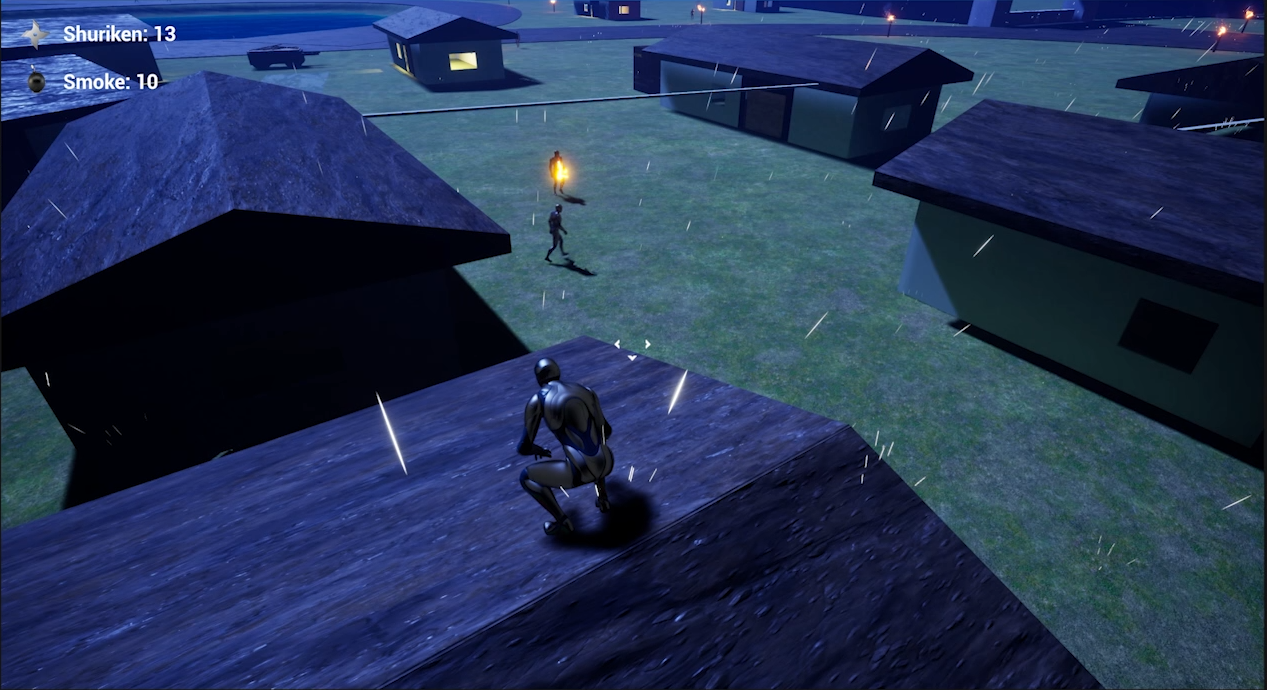
Scaling walls, leaping rooftops, and using the environment are essential. Sound propagation is tied directly to movement; footsteps on different surfaces change detection risk. Running while crouching is impossible; silence requires a slow, deliberate pace.
Player Choice & Strategy
Multiple paths through each section offer different risk/reward trade-offs. High-risk rooftop routes are faster; ground-level routes require more patience but are safer. Neither approach is forced; player agency is central.
Tension & Reward
Avoiding detection is inherently thrilling. Reaching each zone undetected delivers genuine satisfaction. Difficulty escalates progressively: the sparse farm introduces mechanics; the dense village demands mastery.
A semi-realistic art style heavily inspired by classic Japanese aesthetics. The village features paper lanterns, wooden bridges, and dimly lit pathways. The nighttime setting makes shadows into safe zones; darkness is not just atmospheric but a gameplay resource. The player's ninja gear is designed for function and style: traditional black robes, silent footwear. Primary inspiration: Ghost of Tsushima.
Scout patrol routes → choose your approach (rooftop, shadow, or distraction) → execute using parkour and tools → evade detection or hide → move closer to the castle.
Designed around Schell's (2008) principle of unified theme: every mechanic, movement, sound, AI detection and distraction tools serve the single core fantasy of being a ghost moving through a hostile world. As Adams & Dormans (2012) note, hidden mechanics like visibility and sound propagation are crucial to a balanced stealth experience. The design is intentionally stealth-required, not stealth-optional — matching the design pillar that patience is the player's greatest skill.
Rooftops & ledges (elevation scouting), doors (building entry points), carts & lockers (stealth cover), distraction items (smoke bombs and shuriken to lure guards). A minimalist UI shows smoke bomb / shuriken counts in the top-right corner; a dynamic reticule changes shape near interactable doors; contextual prompts appear near carts and lockers.
The level is structured as a semi-open village leading up to the castle, dense with houses and rooftops providing multiple progression routes. Difficulty escalates deliberately across three zones, each with a distinct character and challenge.
ZONE 1: FARM (STARTING ZONE)
The player arrives at the edge of a river near an outlying farm. Sparse enemy placement; this zone is a teaching space. Players learn guard movement patterns, test smoke bombs, and discover that farmyard animals are a detection hazard. The mechanics are introduced with low stakes.
ZONE 2: VILLAGE
A dense, populated centre requiring mastery of all mechanics. Multiple rooftop routes bypass samurai patrols. Buildings can be entered; sightlines are tighter. A guard checkpoint marks the transition from farm to village; entry requires advanced parkour. The pace of decision-making increases significantly in the crowded centre.
ZONE 3: CASTLE GROUNDS
The castle gates are heavily guarded. Multiple options remain: scale the walls directly, use distractions to create a gap, or exploit the architecture. Combat is never an option. Successfully reaching the castle grounds is the level's climax; by this point, all mechanics should feel second nature.
Audio cues are critical to tension. The player's footsteps propagate noise to nearby guards; only crouching enables silent movement. Surface type matters. Farmyard chickens act as environmental detection triggers, scattering and alarming nearby patrols when the player gets too close. Guards respond dynamically to both sound and direct line of sight, following patrol routes but diverting when alerted.
Tenchu : classic stealth gameplay mechanics. Assassin's Creed : parkour and open-world movement. Ghost of Tsushima : Japanese setting and aesthetic. Mark of the Ninja : precision-based stealth mechanics. The level design theory draws on Totten (2019) for architectural spatial flow, and Stone Librande's GDC fundamentals for communicating game systems visually.
The stealth design pillar was consistently adhered to throughout. The combination of evasion and distraction techniques complemented the design intention. Difficulty scales naturally across the three zones — the farm eases players in while the dense village middle section forces faster, higher-stakes decision-making. The progression from sparse to crowded successfully changes the feel and tempo of play without introducing new mechanics.
The level could be enhanced with formal dark zones : dedicated shadow safe areas where guard visibility is blocked by low light levels. This could be implemented either through more complex AI detection logic or by placing collision volumes in low-light areas to block guard patrol paths. This would better reward players for environmental awareness and add a clearer stealth resource to manage.
The design is grounded in Schell's (2008) argument that a unified theme strengthens all elements simultaneously; here, stealth is the single theme governing movement, AI, tools, UI, and level structure. Adams & Dormans (2012) highlight how abstracting hidden mechanics like visibility and sound propagation are crucial to a balanced experience. Totten (2014) notes that properly sequenced cover points and hiding spots create exciting gameplay scenarios — directly applied in the farm-to-village-to-castle escalation of spatial complexity.
References: Schell, J. (2008) The Art of Game Design. Adams, E. & Dormans, J. (2012) Game Mechanics: Advanced Game Design. Totten, C. (2019) An Architectural Approach to Level Design. Kremers, R. (2009) Level Design: Concept, Theory, and Practice. Librande, S. (2012) GDC Vault.
Video Summary: approx. 10 mins
A full level walkthrough from dusk at the docks through to the castle grounds, followed by a detailed design commentary covering technical implementation decisions and post-project reflection.
The video opens with the protagonist arriving at the warlord's town after nightfall. The outlying farm acts as the teaching zone: gentle guard patrols and strategically placed chickens funnel the player into the correct path while introducing crouching as the only truly silent movement mode. A river crossing provides the first chokepoint: the bridge can be entered by vaulting the gate or climbing a guide rope up to a watchtower.
Level Progression
Technical Highlights
Design Reflection
Two mechanics were cut during development: a sliding move (enjoyable but purposeless) and a bow-and-arrow that conflicted with the stealth-first core pillar. Both remain dormant in the build for potential re-integration. A noted future improvement is a light-based detection system to block guard sight lines in unlit areas, reinforcing the "shadows" promise of the title.
3
Distinct Zones
4
Enemy Types
5
Core Loop Steps
GROUP PROJECT: GARETH, LUKE & STE
MY CONTRIBUTION
The branching script for Scene 04: "Winter's End" and the interactive Figma prototype are my individual work within this group project. World-building, lore, and narrative direction were developed collaboratively with Gareth and Luke.
An all-action FPS similar to Metro where a super soldier must discover and foil a plot to destroy New Russia in an alternate dystopian timeline. Set in a 1930s world where Russia, empowered by the mysterious Tunguska Brew, won the Great War and now dominates the globe through eight megalithic cities, each ruled by genetically enhanced soldiers loyal to Tsar Nicholas II and his right hand, Rasputin.
Narrative Designer & World Builder, responsible for the branching script for Scene 04: Winter's End, character arcs, act structure, and the interactive Figma prototype demonstrating all decision paths and their consequences.
In 1908, an asteroid exploded over Tunguska, Siberia, the largest impact event in recorded history. In our timeline it flattened 80 million trees and remained a mystery for decades. In Red Winter, the asteroid carried a substance that mutated surrounding plant life. Russian scientists synthesised this into an elixir called The Tunguska Brew, which creates super soldiers: faster, stronger, and rapidly matured into adulthood within days of induction.
Tsar Nicholas II, who in reality was forced to abdicate and executed in 1918, uses the Brew secretly in World War 1, giving Russia a decisive advantage. A catastrophic global war breaks out as other nations reverse-engineer the Brew. Most of the world is destroyed. The eight surviving nations fortify into Megalithic Cities separated by wild, dangerous lands. Tsar Nicholas II and Rasputin are now seen as Demi-God figures. The game is set in the 1930s of this world.
TUNGUSKA BREW
Creates super soldiers. Advances human intelligence. Kept secret until WW1. Reverse-engineered by foreign nations, triggering the Global War.
NEW RUSSIAN MILITARY
Recruits children from age 10. No way out once inducted. Loyal to the Tsar and Rasputin. Equipped with advanced technology. Valek's surrogate family.
8 MEGACITIES
Survivors of the Global War. Cities separated by Wild Lands. Shadow operatives control the wildlands. Citizens are forced to conform.
The aesthetic draws on dystopian fiction: Equilibrium (2002) for its monolithic state control and black-clad enforcement, V for Vendetta (2005) for its surveillance society, and the Hunger Games / Divergent series for its faction-based world structure. In gaming, the closest comparisons are Halo's super-soldier mythology, Metro's post-apocalyptic claustrophobia, and Call of Duty's set-piece military storytelling.
The team identified key challenges: accurately extrapolating the alternate timeline from real historical events, maintaining uniqueness in a saturated military FPS market, and ensuring the setting does not trivialise the real-world ongoing conflict in Ukraine/Russia. Content warnings were also considered for PTSD sufferers given the military themes.
Valek Mikhailov
Protagonist
Taken from his family on his 10th birthday and inducted into the New Russian Military. Induced with the Tunguska Brew, he is rapidly matured into adulthood, faster, stronger, and more intelligent. Rises from Private to Sergeant to Captain over the course of the game. Determined, skilled, and relentless. His loyalty to the state is tested when he uncovers Rasputin's treachery.
Rasputin
Main Antagonist, Right Hand of the Tsar
The historical Rasputin assassinated in 1916 survives in this timeline. His influence is absolute. He secretly conspires with foreign enemies to destroy New Russia from within, motivated by his own hunger for the throne. Desperate, cunning, and trying to escape.
Tsar Nicholas II
Ruler of New Russia
In this timeline he never fell; instead rising as a Demi-God figure who won the Great War. His autocratic will is absolute. Absolute ruler; word is law, authority is unquestionable. Yet even he is blind to the treachery beside him.
President Roosevelt
President of the USA
Leader of a weakened USA that survived the Global War. Allied with Rasputin in a plot to destroy New Russia. Cool-headed, strategic, but eager to leave. Offers Valek a dangerous truth about the real nature of the war.
Valek's squad in the New Russian Army (NRA) includes Capt. Alexsi, Lt. Dmitri, Pvt. Vladimir, and Pvt. Baldrik , his surrogate family unit after being taken from his parents, Anya and Piotr Mikhailov.
The story blends implicit and explicit storytelling. Valek's 10th birthday party (playable) shows the angst of his parents without spelling it out. The explicit counterpoint is the cutscene of troops arriving and taking him away. Later, a playable mission in an enemy base has Valek discover evidence of a mole; this is explicitly confirmed by a cutscene of Rasputin conversing with the enemy.
ACT 1: SETUP
ACT 2: RISING TENSION
ACT 3: CLIMAX
Depending on player choices: Valek is promoted to Major and hailed a hero of New Russia; or foreign nations recognise New Russia is weakened and begin to plot against it; or Valek defects entirely and helps orchestrate the destruction of the empire he served. Three distinct endings all emerge from one branching scenario.
Scenario 04: The Predicament. A branching scene offering multiple paths that fundamentally alter the ending.
Near the end of the game. Valek has uncovered Rasputin's treachery and chases him to the rooftop helipad. An aircraft is waiting, and on board is President Roosevelt of the USA. Two drones are targeting Rasputin. Valek arrives with his rifle raised. The player must now choose their approach.
PATH 1: CONFRONT THE PRESIDENT
Valek addresses the President directly. The President reveals a dangerous truth about the war, and about Valek's real family. Valek lowers his weapon and boards the helicopter. Together with Rasputin and the President, he orchestrates a strategic attack on New Russia while civilian evacuations run simultaneously. Valek watches his homeland burn, but finds his parents.
Ending: Valek defects. New Russia destroyed. World rebuilds.
PATH 2: TACKLE RASPUTIN
Valek lunges at Rasputin and physically restrains him. The President escapes. Valek delivers Rasputin to the Tsar, but from here a second choice branches:
Tsar's choice: Valek executes Rasputin in the throne room. Rasputin reveals a hidden dagger mid-execution and lunges for the Tsar. Valek shoots him dead. The Tsar reigns supreme.
Rasputin's choice: Valek advocates for a public trial at the Gulag. The Tsar agrees. Rasputin is imprisoned. Valek is promoted to second in command, Rasputin's former position.
Endings vary: execution or imprisonment of Rasputin; Valek rises to power.
PATH 3: TACKLE RASPUTIN, THEN ENGAGE THE PRESIDENT
Valek restrains Rasputin, but the President's parting words plant seeds of doubt. Valek delivers Rasputin to the Tsar, but in the throne room, shaken by what he heard, Valek turns his rifle on the Tsar himself. Rasputin, stunned, steps forward and crowns himself Tsar Rasputin I, appointing Valek as his second in command.
Ending: The Tsar is dead. Rasputin rules. Valek chose the "truth."
The scenario is deliberately designed so that no single path feels obviously "correct." The Tsar is autocratic; Rasputin is treacherous; the President's motives are self-serving. Valek's decision must be made under time pressure, with incomplete information, mirroring the moral ambiguity faced by real soldiers following orders they don't fully understand. The branching structure was prototyped in Figma to map all decision trees before scripting.
The complete branching script for Scene 04, including all dialogue, stage directions, and camera instructions across all paths and sub-branches.
The branching narrative was prototyped in Figma to visualise all decision paths before scripting. The interactive prototype lets you play through all three paths of Scene 04, clicking through each branching choice as a player would experience them.
SCENE 04: THE PREDICAMENT
Interactive Figma prototype: all branching paths playable
VIEW PROTOTYPE →The Figma prototype maps all three primary paths and their sub-branches, including the full rooftop confrontation, all three endings, and the throne room scenes. It was built to serve as a communication tool between the narrative designer and the rest of the team, ensuring all paths were accounted for before committing to the final script.
Video Summary: approx. 8.5 mins
A complete walkthrough of the interactive Figma prototype for Scene 04: "Winter's End", demonstrating all three branching paths and their outcomes. The scene opens on a rooftop helipad at dusk, with protagonist Valek Mikhailov pursuing Rasputin towards a waiting helicopter carrying representatives of the USA.
Each branch is driven by Valek's governing trait (duty-bound soldier, indoctrinated from youth) in tension with a conflicting trait (growing political awareness and doubt). The player's choice at each decision point determines which trait wins — and which faction inherits New Russia.
Branching Paths Demonstrated
Path A: Critical Path (Duty)
Valek follows orders, arrests Rasputin, and delivers him to the Tsar's palace. At the final choice point he carries out his last order: shooting Rasputin dead. The Tsar remains absolute ruler of New Russia.
Path A (Alt): Soldier's Ambition
At the final choice, Valek demonstrates his political value rather than just executing orders. The Tsar recognises this; Valek replaces Rasputin as second in command.
Path B: The President's Doubt
After initial contact with Rasputin, Valek engages the President, who attempts to explain that Valek is serving the wrong side. Valek is unconvinced but shaken. He still arrests Rasputin and delivers him to the Tsar; from here can either send Rasputin to the Gulag and become 2nd in command, or shoot the Tsar, installing Rasputin as the new ruler of New Russia.
Path C: Defection
Valek chooses the President at the first branch; his conflicting trait overrides his governing one entirely. He defects, boards the helicopter to America, and is reunited with his real family (evacuated from Russia). The Tsar's empire collapses live on US television.
2D PIXEL PLATFORMER, UNITY, GAD5003
It's the 1980s. Michael heads to his friend Jessica's house for a Dungeons & Dragons session, but as dusk falls on the small town of Eerie Hills, the birds go silent, and the recently departed begin to rise from the local graveyard. Stranger Natural is a 2D pixel art side-scrolling platformer built in Unity, blending 80s horror aesthetics with classic arcade gameplay. Three distinct zones: street, house, and graveyard/church — each with unique platforming structures, enemies, and weapons.
The Brief
Design and build a 2D pixel platformer with three distinct zones, multiple weapon types, a horror aesthetic, and a fully documented GDD.
Role
Solo Designer & Developer
Timeline
2024
Engine / Tools
Unity
Module
GAD5003 · UoGM
Sole Designer & Developer: GDD authorship, level design across all three zones, weapon system design, enemy design, Unity implementation.
The game unfolds across three zones, each with a distinct visual style, platforming vocabulary, and enemy set. Difficulty and enemy variety escalate progressively: the street teaches the basics, the house introduces ranged combat and key-hunting, the graveyard demands mastery of everything.
LEVEL 1: THE STREET
Side-scrolling at dusk. Michael passes bins, fences, and brick walls forming a three-tier platforming system. Fences allow access over road obstacles (potholes, workman holes) and up to wall tops. The graveyard gate requires a key found later inside Jessica's house.
Platforms: Bins, fences, walls, post-boxes, gravestones
Enemies: Ghosts only
Weapon found: Cross (graveyard gate pickup)
LEVEL 2: JESSICA'S HOUSE
Gameplay shifts to per-room screens rather than side-scrolling. Each room is a self-contained platforming challenge using household furniture. Locked doors require keys hidden in the rooms. Collecting all Master Key parts unlocks the graveyard gate.
Platforms: Chairs, tables, sofas, fridges
Enemies: Ghosts + Ghasts
Weapons found: Shotgun (salt shells), Iron Railing (on street return)
LEVEL 3: GRAVEYARD & CHURCH
Back to single-screen layout: multi-tier platforms using gravestones, crosses, raised crypts and fences. Zombies emerge at ground level. The church contains the Plastic Bottle (holy water weapon) and the crypt entrance where the Spectre boss must be destroyed.
Platforms: Gravestones, crosses, tombs, crypts, chandeliers, lifts
Enemies: Ghosts, Ghasts, Zombies, Spectre (boss)
Weapon found: Plastic Bottle (holy water)
TALL PLATFORMS
Crosses/headstones, furniture, small tombs, brick/stone walls. Walls require ascending from a short platform first.
SHORT PLATFORMS
Bins, fences, furniture, gravestones, tall tombs, post-boxes. Most common; form the base layer of traversal.
MOVING PLATFORMS
Tyres (sewers, left-right), Chandeliers (catacombs, swing under weight), Lifts (vertical, reach new areas).
Potholes (jumpable), workman holes (must use fences to cross), locked doors (require keys), pits (links to hell, require platform chains; falling respawns at last checkpoint). Bins and gravestones double as both platforms and obstacles depending on context.
Four weapons cycle via keys 1–4. Melee weapons trigger a swoosh SFX; ranged weapons play distinct bang or squirt sounds. Weapon effectiveness varies by enemy type; choosing the right weapon is part of the challenge.
CROSS: Melee (Key 1)
Found on the graveyard gate. A holy cross that destroys Level 1 Ghosts on contact. Press attack; any enemy in range is hit. Effective against: Ghosts only.
Pickup: Graveyard gate (Level 1)
IRON RAILING: Melee (Key 3)
A pointy piece of wrought iron fence. Destroys all levels of apparitions, including Ghasts that the cross cannot harm. Effective against: Ghosts, Ghasts, Zombies.
Pickup: Street (on return from Jessica's house)
SHOTGUN: Ranged (Key 2)
Jessica's father's shotgun. Fires salt shells, longer range than the bottle. Limited ammo; salt shells can be collected throughout levels with no maximum carry limit. Effective against: Apparitions, Zombies (multiple blasts).
Pickup: Jessica's house (Level 2)
PLASTIC BOTTLE: Ranged (Key 4)
Filled with holy water at refill points in the church. Shorter range than the shotgun. 10 shots per fill; can be refilled at any time but cannot overfill. The only weapon that destroys the Spectre boss. Effective against: All enemy types.
Pickup: Church (Level 3)
Enemy escalation is deliberate: each zone introduces a new threat that forces the player to adapt their weapon strategy. Aerial enemies (Ghosts, Ghasts, Spectres) can attack at any platform level; only Zombies are ground-bound.
Ghost: Level 1
First enemies encountered on the street. Vulnerable to all four weapons. Float through the air and can attack at any height.
First appears: Level 1 street
Ghast: Level 2
Stronger apparition introduced on the return to the street. Immune to the Cross : requires Iron Railing, Shotgun, or Holy Water. Floats; attacks at any platform level.
First appears: Street (return journey)
Zombie: Level 2
Ground-level only. Shambles along the floor and can only be destroyed by the Iron Railing or multiple shotgun blasts. Cannot float or attack elevated players.
First appears: Graveyard (Level 3)
Spectre: Boss
The end-level boss residing in the church crypt. The source of the undead rising. Can ONLY be destroyed by Holy Water : the Plastic Bottle is essential. Floats; attacks at any height.
Final encounter: Church crypt
Health bar runs 0–100%. Enemy contact reduces health continuously; the longer contact is maintained, the more damage taken. A 'slap' SFX plays on damage; a melancholy jingle plays at zero. Health restores via chocolate bars and drink cans (+1 minor, randomly dropped) and first aid kits (+2 major, scarce, house and church only). Keys unlock doors; Master Key parts (collected throughout the house) assemble to unlock the graveyard gate.
Designed for fans of classic arcade platformers of all ages, with a particular pull for the 30–50 age bracket through deliberate 80s nostalgia: pixel art, horror-themed level design, and an 8-bit inspired soundtrack. The game is approachable for casual players but rewards mastery through weapon selection and spatial awareness.
All characters and enemies are animated pixel art. Backgrounds are pixel art street scenes showing dusk falling and streetlights activating; darkness is both aesthetic and narrative. House and church sections use individual room screens rather than side-scrolling, creating a deliberate shift in pacing. The art draws from classic 80s pixel horror aesthetics.
START SCREEN
Instrumental of "Somebody's Watching Me" (Rockwell), setting the tone of creeping dread immediately.
STREET SCROLLING
"Maniac" (Sembello) and "Sweet Dreams" (Eurythmics): upbeat but ominous 80s energy.
THE HOUSE
"Ghostbusters" (Ray Parker Jr.): familiar and playful, undercutting the tension with nostalgia.
THE CHURCH
"Thriller" (Michael Jackson): the climactic zone earns the most iconic track. All rendered in 8-bit format for immersion.
The GDD documents several key design pivots: the game was initially planned for multiple levels but scoped to one level to meet time constraints. The protagonist's name changed from Michael/Jessica to Steve/Jen to avoid associations with horror villain names. The Cross weapon shifted from ranged to melee, and a new melee weapon, "holy trainers",, was introduced to evoke Mario Bros. nostalgia before being replaced by the Iron Railing. AI-generated character voice dialogue was added late in development to complement the written backstory.
The complete GDD covering all systems, level structure, weapons, enemies, pickups, sound design and art direction.
Video Summary: approx. 7 mins
A combined gameplay walkthrough and design presentation covering the full three-act structure of Stranger Natural, from the opening street scroll to the final confrontation inside Jessica's house, with commentary on inspiration sources, design theory applied, and two playtesting iterations.
The video opens by contextualising the game's inspirations: Ghosts 'n Goblins and Super Mario Bros for platformer mechanics; Stranger Things, Supernatural, Ghostbusters and The Evil Dead for tone, setting and enemy logic. The narrative premise, a teenager walking to his friend's house to play D&D, is established through opening dialogue between Steve and Jen before the side-scrolling gameplay begins.
Three-Act Structure
Design Theory Applied
Playtesting
Two playtesting phases were conducted using feedback forms with anonymous demographics to capture views across different audiences. Results were quantified in graphs and used to drive iterative changes to mechanics and pacing throughout the development lifecycle.
3
Zones
4
Weapons
4
Enemy Types
80s
Setting
The Brief
Create horror through environmental design alone: no monster, no jump scare. Only space, light, and what's left behind.
Role
Solo Level Designer
Timeline
2024
Engine / Tools
Unity
Module
GAD4002 · UoGM
A sci-fi/horror walking simulator inspired by 1970s and 80s horror films. Focuses on atmospheric design, environmental storytelling, and creating tension through level design and pacing.
Level Designer & Technical Designer
Main Horror Environment
Tension Building Corridor
Full Walkthrough
Creates horror through atmosphere and suggestion rather than jump scares. Inspired by 1970s and 80s horror films, the design emphasises building tension through environmental storytelling, unsettling sound design, and carefully crafted lighting. The true horror emerges from what's implied rather than explicitly shown.
Early areas establish normalcy before subtle wrongness creeps in. Mid-game sections build dread through isolation and atmosphere. The climax delivers on built tension without relying on cheap scares, maintaining the film-inspired tone throughout.
UI/UX DESIGN & TCG, UNITY / FIGMA, GAD5006
The Brief
Design the complete UI/UX system for a multiplayer TCG: from information architecture through three iterative Figma prototyping and playtesting cycles.
Role
UI/UX Designer + Developer
Timeline
2024
Engine / Tools
Unity + Figma
Module
GAD5006 · UoGM
Dragons & Wizards is an immersive multiplayer competitive Trading Card Game (TCG) set in the mystical realm of Sadratein, a world torn apart by four powerful elemental factions: Air, Earth, Fire, and Water. Players choose a faction, build decks of powerful Wizards, Warriors, Healers, and Beasts, and battle to reduce their opponent's life points to zero. The project's primary focus was UI/UX design , designing, prototyping, and iteratively testing a complete game interface system, while simultaneously building a working card game in Unity.
Sole Designer & Developer: UI/UX Design, Figma wireframing & prototyping, Unity implementation, user testing methodology, iterative design across three playtest cycles.
A competitive TCG in the tradition of Hearthstone and Magic: The Gathering, grounded in a fully original fantasy world. Players choose one of four elemental factions, each with distinct playstyles: Air (agile, strategic), Earth (sturdy, defensive), Fire (aggressive, spell-heavy), and Water (illusion and healing). Each match features a random battle location and a random musical score, so no two games feel identical.
Hero Cards
Powerful units with unique abilities. Can aid allies or attack opponents directly.
Creature Cards
Warriors, Clerics, Rogues, and more. Five tiers: Legendary, Epic, Rare, Common, Basic.
Spell Cards
Instant or ongoing effects that impact the battle. Some increase Mana generation.
Each player starts with 30 life points and is dealt five cards from a 30-card deck. Mana generates one point per turn (some spells increase this). On your turn, choose a card to attack the opponent or their creatures; the resolved damage is applied to the defending player. The turn ends by timer or clicking End Turn. Win by reducing the opponent's health to zero.
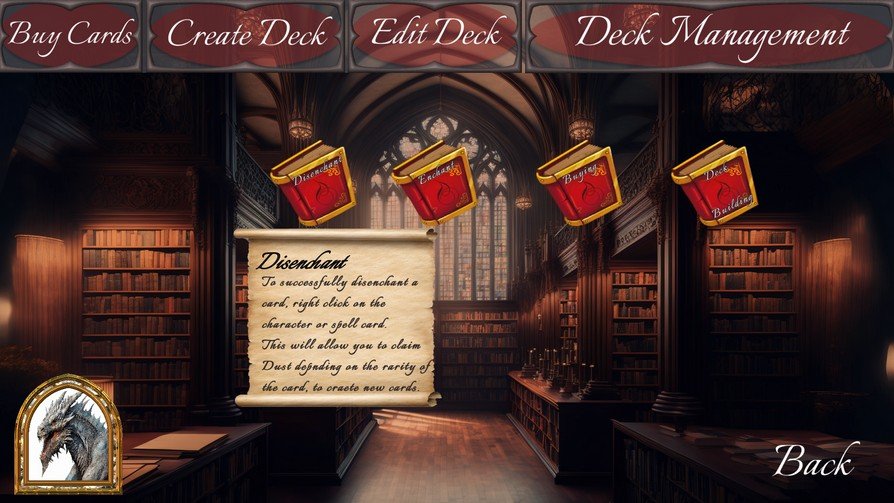
New cards are bought in packs of five from the Shop using in-game gold, or crafted by disenchanting duplicates into dust. Decks contain ten cards; no card type may appear more than twice.
Air: Onus
Agile and strategic. Wind manipulation and aerial combat. Best for experienced players who want speed and unpredictability.
Earth: Gnutra
Born from stone, sturdy and defensive. Outlasts opponents through endurance and fortification.
Fire: Poirus
The most aggressive faction. Powerful spells and fiery daemons. High risk, devastating payoff.
Water: Akoria
Peaceful water folk. Illusion, curative, and elemental magic. Distracts and heals; frustrating for aggressive opponents.
The UI system was built on Atomic Design principles , designing reusable components from atoms upward, ensuring visual consistency across all screens. Font choice was deliberate: Italianno throughout (regular and outlined variants) on plain white/black to ensure readability over the richly painted fantasy backgrounds. The art direction draws from Forgotten Realms and classic fantasy novel illustration.
The UI was designed as a complete interconnected system, each screen set against a contextually appropriate environment:
ENTRY FLOW
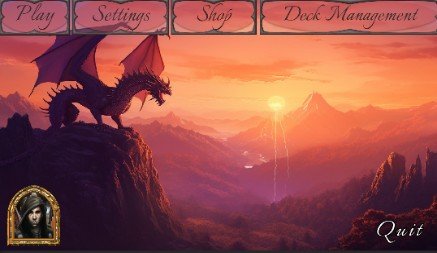
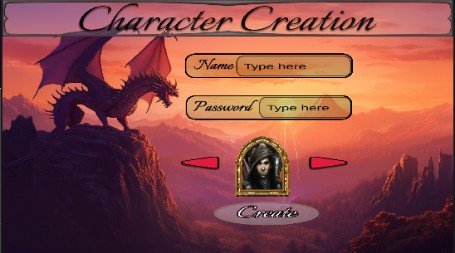
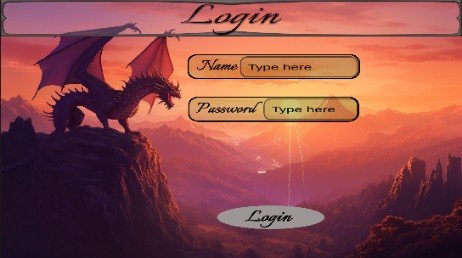
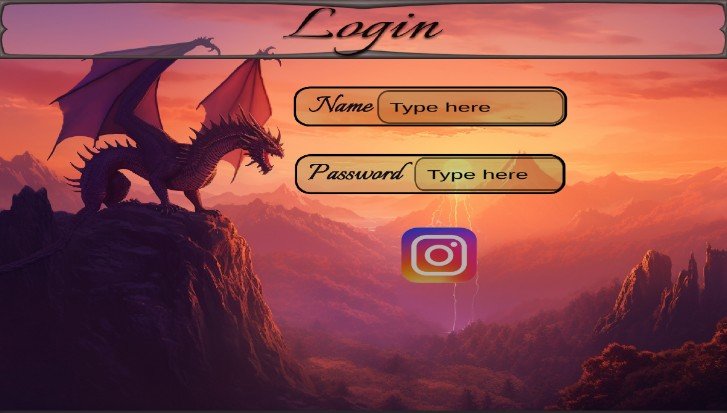
Splash screen (dragons over castle) → dragon valley sunset → animated title → Login / Create Character. Avatar selection with left/right arrows. Facebook & Instagram OAuth login options.
MAIN MENU
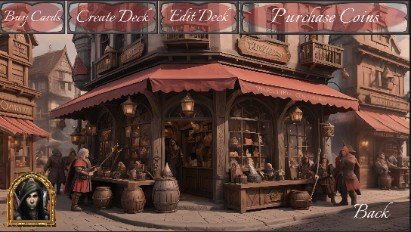
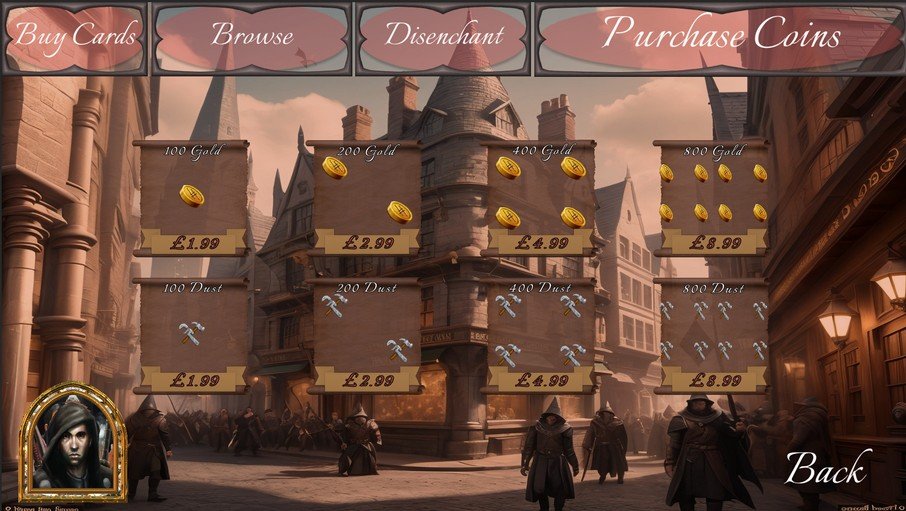
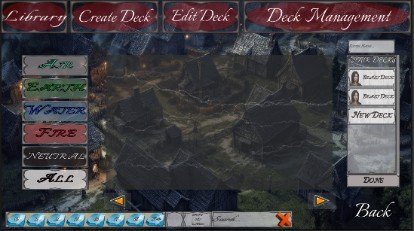
Play / Settings / Shop / Deck Management / Quit. Each option routes to a contextual environment: Street Scene for Shop, Barracks for Deck Management, Bank for coin purchases, Library for help.
PLAY MODES
Tutorial (CPU vs CPU), two-player (PvP local), single player (vs AI). Online lobby for matchmaking. AI difficulty from Novice to Wizard.
IN-GAME UI
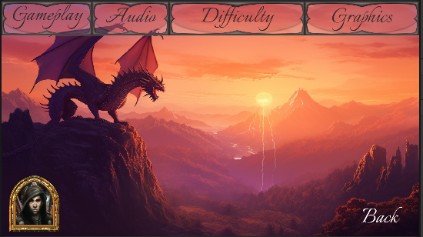
Minimalist in-game overlay. Pause canvas appears over gameplay. Resume / Options / Main Menu. Full settings: graphics quality, resolution, VSync, audio volume, SFX controls.
Three login pathways were designed: in-game account creation, Facebook OAuth, and Instagram OAuth. The rationale was audience-specific: the target demographic trust social login for speed and perceived security. The Hawthorne Effect was considered in testing; knowing they were observed affected participant behaviour, which was factored into result analysis.
An unmoderated, remote testing approach was adopted for reach and cost efficiency, supplemented by in-person sessions where direct observation of non-verbal cues (facial expressions, body language) added qualitative depth. Each round used four linear scale questions and two open-ended questions, with an additional screening question from round two onward to track returning vs. fresh participants. The Hawthorne Effect was acknowledged as a limitation of observed sessions.
PLAYTEST 1: 6 TESTERS
Feedback: Responses spread evenly. Font style, size, and colour were difficult to read. Ellipse-shaped buttons blended into backgrounds.
Changes: Complete font system overhaul. Menu buttons redesigned with distinctive frames separating them from backgrounds.
PLAYTEST 2: 5 TESTERS
Feedback: Clear positive shift. Font improvements were noted. Deck management background change well received, though immersion broke when navigating to other pages.
Changes: All game-adjacent sections updated with contextual background environments (Street, Barracks, Bank, Library).
PLAYTEST 3: 6 TESTERS
Feedback: UI positively received overall. Deck management section still confusing for new players unfamiliar with TCG conventions.
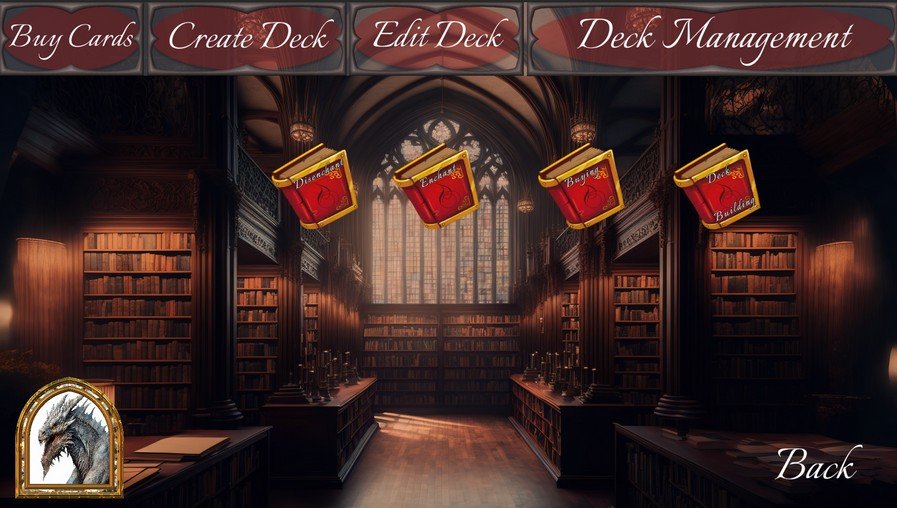
Changes: Library section implemented: a dedicated in-game help area with guided deck-building tutorials for new players.
Each playtest followed a structured iterative loop: feedback received → prioritised by criticality and impact → changes implemented → documented in the change log → next playtest. This mirrors Hodent's (2017) UX methodology applied to game design — treating the UI as a cognitive experience to be refined, not just a visual layer to be polished.
The entire UI was designed and prototyped in Figma before any Unity implementation began. The flow diagram maps every screen and its connections. The interactive prototype allows users to navigate the full UI system as a player would experience it.
The full UI journey from splash screen through character creation, login (including Facebook and Instagram flows), main menu, play mode selection, shop (Street Scene / Bank / Wizard's Shop), deck management (Barracks / Library), settings, and in-game pause menu. Every connection between screens was mapped and validated in Figma before Unity implementation — allowing user testing to begin on the prototype before writing a single line of code.
All screens designed in Figma and implemented in Unity. Each background environment was chosen to reinforce the in-world location — barracks for deck management, wizard shop for card purchases, fantasy library for the help system.

Character Creation

Game Login Screen

Social Media Login (Instagram)

Main Menu

Settings (Audio, Graphics, Difficulty)

Shop — Fantasy Street Scene

Purchase Coins — In-World Bank

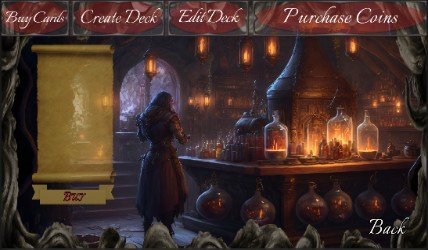
Buy Cards — Wizard's Shop

Deck Management — Barracks

Help Library — Floating Books

Library — Help Scroll on Hover
In-Game Battle Screen
The full GDD covering concept, gameplay, card mechanics, factions, deck building, Figma flow diagrams, all UI screen specifications, user testing methodology, three playtest cycles with analysis, social media integration, and references.
GAD5006_GDD_Halliwell_Steven · 30 pages
Download GDD PDFVideo Summary: approx. 10 mins
A complete UI walkthrough starting with the Figma wireframe prototype, then moving through the full working Unity build, covering account creation, settings, the shop ecosystem, deck management, the help library, and live gameplay. Three playtesting phases are documented with the specific iterations each round drove.
The project began with zero prior knowledge of trading card games. An external Udemy course was completed alongside the module to understand deck management fundamentals; that knowledge was then implemented directly into a working deck system in Unity. Visual design draws from the Forgotten Realms book series aesthetic, with each UI section designed to feel like a distinct location within the game world.
UI System Walkthrough
Three Playtesting Phases
Fitts' Law applied throughout: all interactive buttons sized large to minimise pointer travel distance and reduce input error.
Technical Implementation
Audio managed via a Unity Audio Manager script controlling the main mixer, allowing music, SFX and speech to be controlled independently. Secure login implemented using PlayFab for credential storage and social media account linking. Multiplayer lobby UI is built but not yet fully connected; flagged for a future sprint. Card rarity and elemental type are randomised on pack opening.
4
Factions
3
Playtest Cycles
15+
UI Screens
5
Card Rarities